
Level 2 Safeguarding Children and Young People
The Gold Standard Neuro-Inclusive Framework
Module 1: Foundations and Professional Practice
As a practitioner, your duty is to teach children what a safe adult relationship looks like. A safe adult is Predictable, Transparent, and Respectful of Agency. We must explicitly instruct children that any adult asking them to keep a secret is a major red flag. In our practice, we model these boundaries by ensuring every interaction is transparently recorded in the DDP and respects the child’s sensory right to say ‘No’.
Professional curiosity is the capacity to explore what is happening beneath a behavior. The Benefit: It allows us to catch cumulative harm by noticing deviations from a child’s DDP baseline. The Risk: If curiosity is applied without a neuro-informed lens, behaviors like stimming or sensory meltdowns can be misinterpreted as ‘aggression’. This misunderstanding leads to the criminalisation of neurodivergent youth. We use curiosity to validate experience, not to punish communication.
Our practice is governed by these core statutory guidance documents:

KCSIE 2026

Working Together 2023

The Equality Act 2010
The Prevent Duty (2015)
You have a statutory duty to prevent people from being drawn into terrorism. Radicalisation is a primary safeguarding harm. We protect neurodivergent learners by promoting British Values: Democracy, Rule of Law, Individual Liberty, and Mutual Respect.
Statutory Thresholds: The Children Act 1989
Section 17 (Child in Need): This applies when a child is unlikely to achieve or maintain a reasonable standard of health or development without the provision of services. It is a support-based threshold focused on reaching the Gold Standard of care.
Section 47 (Child Protection): This applies when there is reasonable cause to suspect that a child is suffering, or is likely to suffer, significant harm. This triggers a mandatory investigation by the local authority.
Professional Anonymisation: If you are describing a real event to illustrate a threshold, instead of saying “Sarah from my class,” you must say “A seven-year-old child with an Education, Health and Care Plan (EHCP).”
ADHD Case Application: A child with ADHD suddenly stops eating. Do not assume it is a ‘medication dip’. Investigate the home context for domestic instability as a priority.
Module 1: Pathway to Success
1. Statutory Justification: Under the Equality Act 2010, what is your Anticipatory Duty regarding neurodivergent child reporting?
2. Threshold Application: You identify that a family is struggling to provide adequate basic needs, but there is no evidence of “significant harm”. Which threshold is met?
3. Escalation Logic: You report a serious concern to your DSL, but after 48 hours no action is taken and the child remains at risk. What is your legal duty?
Module 2: Recognising Abuse, Neglect and Vulnerability
 © Lane Anthony
Case Study 1: Physical Abuse (Sara Sharif)
What happened: Sara endured burns, fractures, and bruising over years. Professionals failed to escalate effectively. She had over 70 injuries at the time of her death in August 2023.
Safeguarding learning: Professional curiosity is critical when caregiver explanations do not align with injuries.
 © Lane Anthony
Case Study 2: Sexual Abuse (Vincent Chan)
What happened: A nursery practitioner who assaulted toddlers while on duty. Vetting alone is insufficient; constant supervision and whistleblowing cultures are essential.
 © Lane Anthony
Case Study 3: Emotional Abuse (Arthur Labinjo-Hughes)
What happened: Subjected to psychological torture and isolation during lockdown. learning: Emotional abuse can be fatal without scars. Look for signs of “fading away.”
 © Lane Anthony
Case Study 4: Neglect (Baby Victoria)
Professional Analysis: Death from exposure following transience. Neglect is an omission of care. Report the very first omission of a basic survival need. When parents avoid medical professionals, the risk is extreme.
Diagnostic Overshadowing: Never assume a change in behaviour is “just the autism.” If rocking increases or aggression starts, treat it as potential communication of harm until ruled out.
Masking/Fawning: Neurodivergent children may “mask” distress to fit in. Fawning is a trauma response where a child appeases adults to stay safe.
Module 2: Pathway to Success
1. Recognition Skills: You notice a neurodivergent learner has become unusually compliant toward a specific adult. Consider:
2. Avoiding the Trap: An autistic child starts displaying self-injurious behaviour. First professional action?
3. Identifying Neglect: Child arrives three times in one week unwashed with body odour. Next step?
Module 3: Professional Conduct and Contextual Safeguarding
 © Lane Anthony
Contextual Risk: County Lines
Criminal exploitation where urban gangs use children to transport drugs. Neurodivergent learners are targeted for their loyalty. Choice is irrelevant; coercion is the mechanism.
 © Lane Anthony
Online Harm: Molly Russell
Algorithmic exposure to self-harm. Use the 4Cs: Content, Contact, Conduct, and Commerce to map digital risk.
Module 3: Pathway to Success
1. Contextual Recognition: Student arrives with new smartphone and trainers from an “unknown friend”. Duty?
2. Child-on-Child Practice: students make unwanted sexual comments toward neurodivergent child. “Banter”? Response?
3. Professional Boundaries: Student sends a direct message on a social media platform asking for help. Action?
Module 4: Responding and Recording (The Mechanics)
The ‘Golden Hour’ is absolute. Human memory is a leaky bucket; body language nuances and exact symbol selections on a communication board are lost within 60 minutes of a disclosure. Record Immediately, Factually, and Chronologically.
Factual Precision: Fact vs Opinion
Remove interpretation from your records. Instead of writing “The child was angry,” write “The child threw two chairs and shouted.” Factual evidence is the only language recognized by statutory thresholds.
Recording Symbolic Disclosure
If a child selects [STOMACH] + [BAD] + [MAN] on their communication device, you must record the exact icons used. Contrast this state with their DDP baseline to provide factual evidence of deviation.
Module 4: Pathway to Success
1. Disclosure Mastery: Child asks, “Do you promise not to tell my mum?”. How must you respond?
2. Factual Recording: Which entry meets the professional standard for accuracy?
3. Neuro-Inclusive Practice: Non-verbal child points repeatedly at SAD face and HOUSE symbol. Next action?
Module 5: Thresholds and Multi-Agency Working
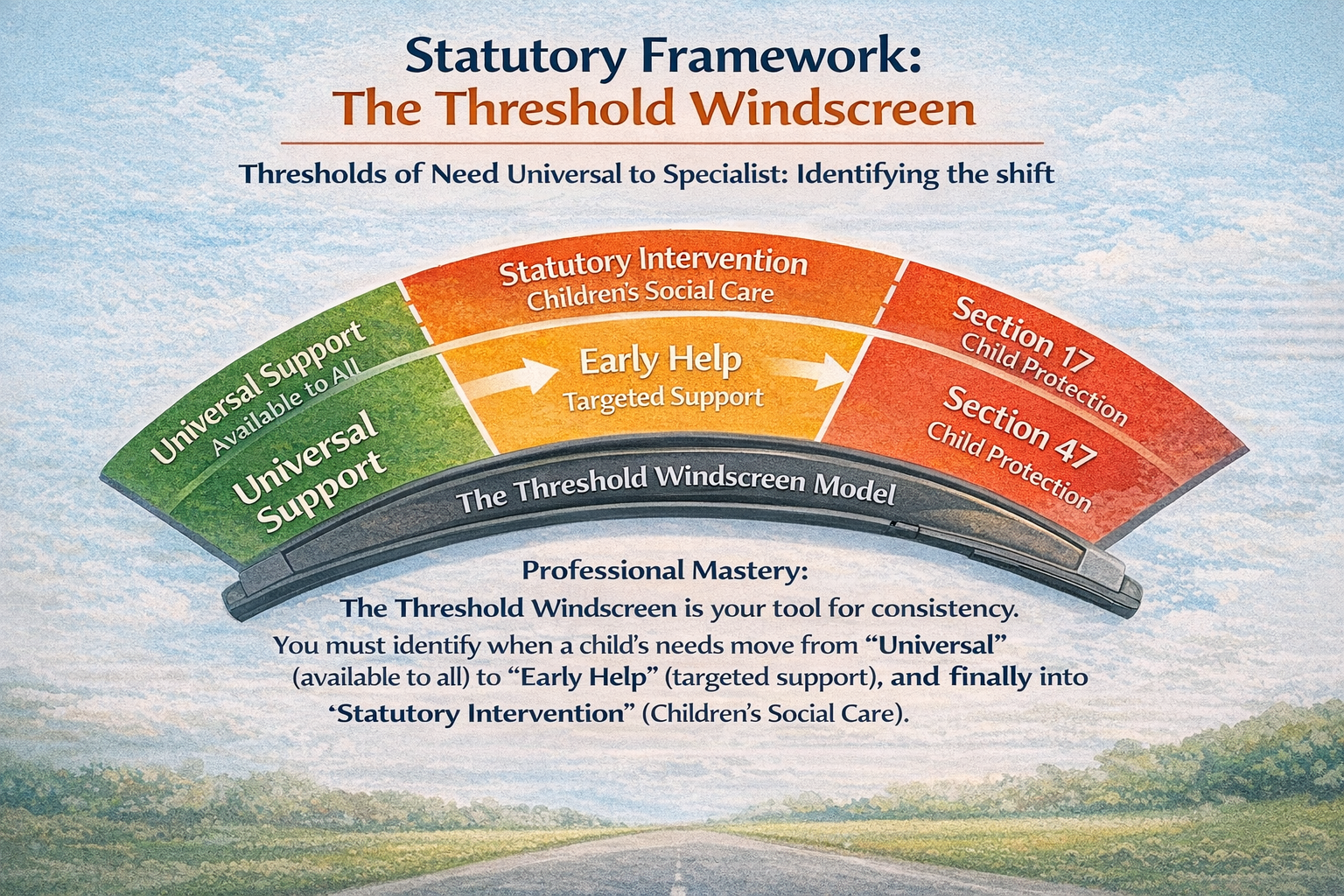
Early Help (Level 2) is the DDP sweet spot. It allows targeted support to identify sensory or communication barriers before they manifest as harm. By the time a case reaches Section 17 or 47, the system is reactive. Use DDP data to advocate for intervention at Level 2.
Distinguishing Poverty vs. Neglect
Is the child hungry but well-loved and parents engaging? This is Section 17 Support (Need). Is there an intentional omission of care? This is Section 47 (Harm). Misusing thresholds can traumatise families; use DDP data to justify the path.
The Duty to Challenge
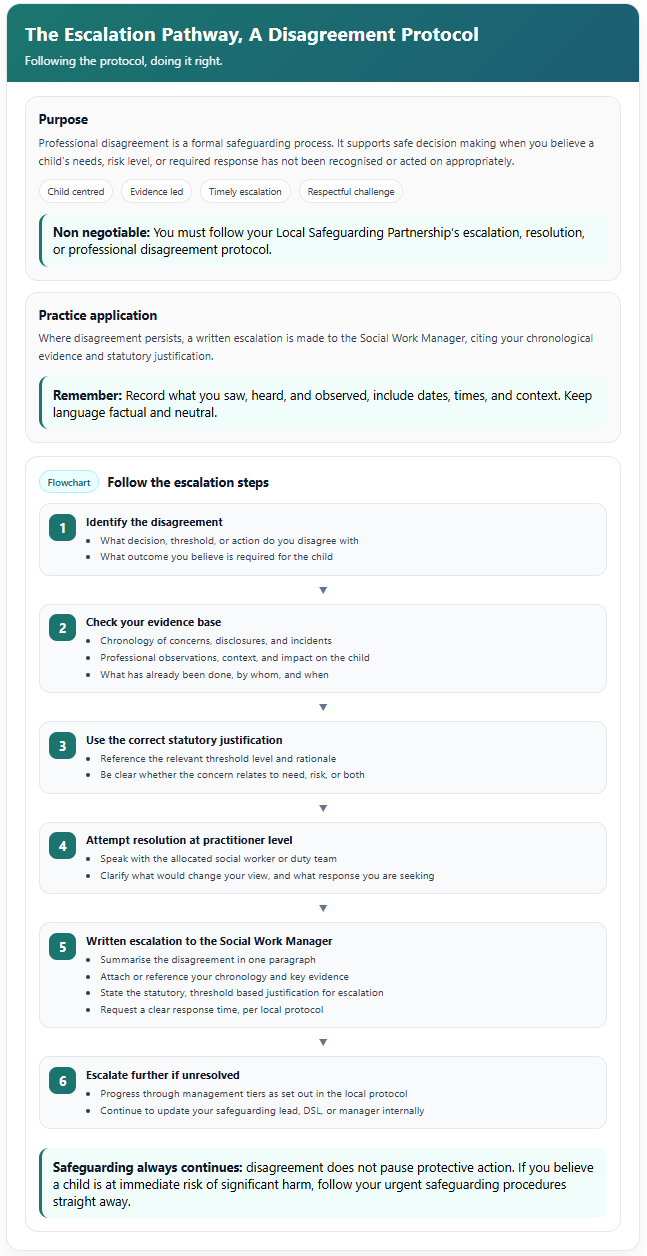
Silence is consent to danger. If a referral is closed but your DDP data shows risk remains, you have a professional duty to trigger the Disagreement Protocol in writing to the Social Work Manager.
 Threshold Assets © Lane Anthony
Module 5: Pathway to Success
1. Threshold Mastery: Home with severe domestic violence and immediate risk of physical harm. Which statutory threshold?
2. The MASH Pathway: referral to the MASH. What should you provide from your individual practice?
3. Escalation Duty: hygiene continues to decline after case is closed. Duty?
Module 6: Safer Culture and Individual Accountability
Loyalty to a colleague is a professional failure if child safety is at risk. Loyalty to the child is the only priority. You are personally liable for your silence; the 24-hour LADO window for allegations against adults is a statutory mandate.
Identifying Boundary Nudges
Low-level concerns are behaviors that nudge professional boundaries (e.g., staff member giving gifts or vapes to ‘build trust’). These are red flags that must be reported to prevent grooming patterns.
Module 6: Pathway to Success
1. Allegation Management: child says popular staff member “touched them in way they didn’t like.” Timeframe to report to LADO?
2. Whistleblowing Practice: observe colleague using aggressive restraint. “For safety.” Action?
3. Safer Culture: colleague “favouring” a student with extra gifts and unobserved 1:1 time?
Final Mastery Access
Complete your assessment on the LearnDash portal. Certification requires statutory confirmation that you have read Part 1 of KCSIE.