NeuroLearn Level 2 Safeguarding – Module 2 Gold Standard

NeuroLearn Safeguarding 2026

Module 2:   Recognising Abuse, Neglect and Vulnerability

Professional Recognition in Practice

Mastering the ability to identify indicators of harm while maintaining a consistent, neuro-inclusive lens through real-world application.

Your Learning Intentions

In this module, you must develop the professional skill to:  

Identify the Four Main Categories of Abuse.
You must be able to recognise the physical, emotional, and behavioural indicators for Physical Abuse, Emotional Abuse, Sexual Abuse, and Neglect.
Apply a Neuro-Inclusive Safeguarding Lens.
You must learn to distinguish between neurodivergent traits and safeguarding indicators through the use of specific case study analysis.

Statutory Categories:   Foundations of Recognition

Working Together 2026
The Duty of Vigilance:   Consistency.
You must understand that abuse is often a combination of factors. While we categorise harm into four areas, you must look for the “interconnectivity” of indicators to form a professional judgement.
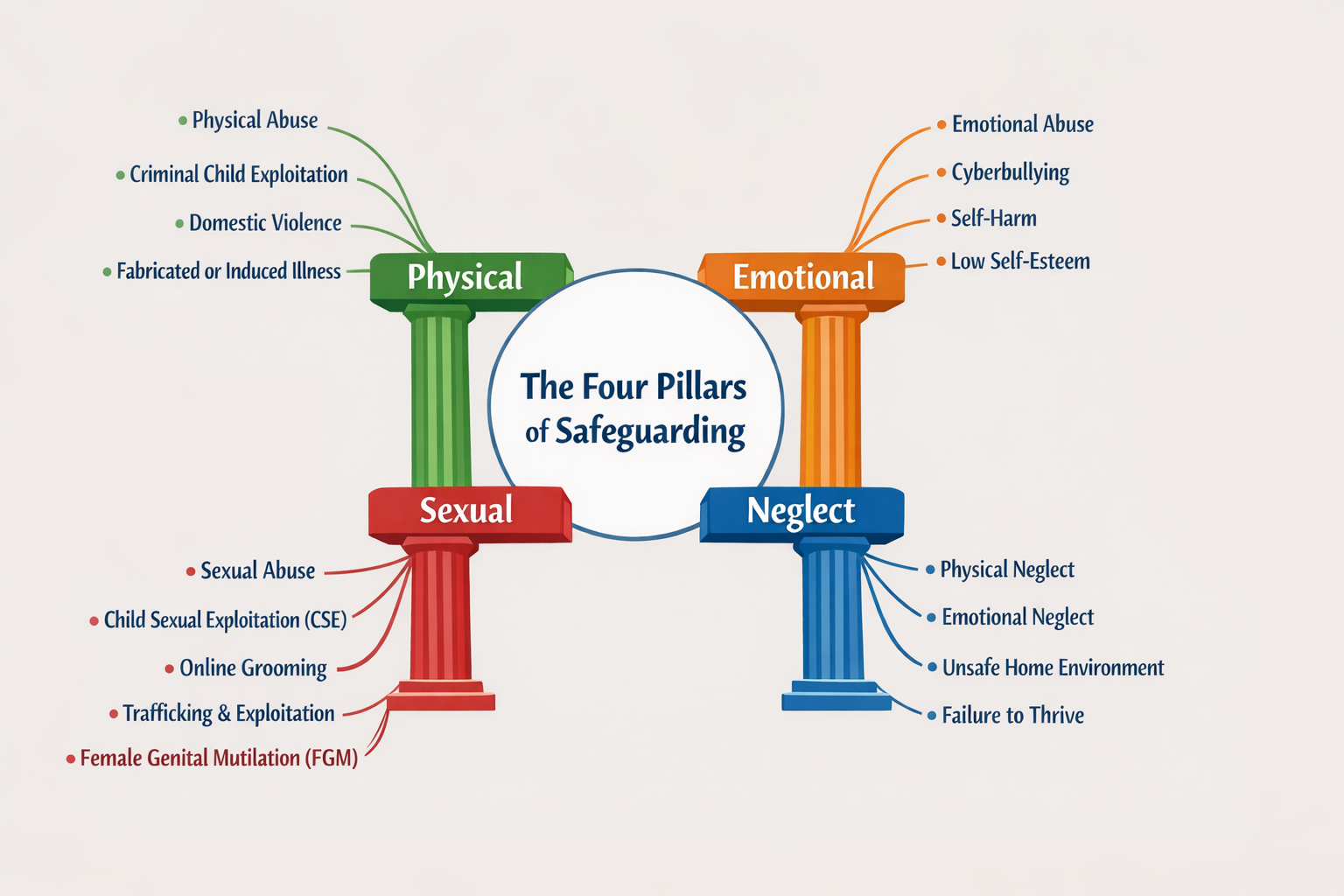
Safeguarding Categories Infographic

Your Practice:   Recognising Physical Abuse

Non-Accidental Injury:   Spotting the indicators.
You must look for bruising in “non-mobile” areas or soft tissue (e.g., ears, neck, cheeks). You must also identify “patterned” injuries that resemble an object or a handprint.
Behavioural Shifts:   Flinching and Avoidance.
Observe if a child becomes flinchy when approached or if they consistently wear clothes to hide their body, even in warm weather. These are non-verbal indicators requiring your professional inquiry.

Case Study:   Sara Sharif (Physical Abuse)

Sara Sharif

Professional Analysis:   Sara Sharif suffered extensive physical abuse that was masked by a narrative of “unruliness” and domestic secrecy.

In your practice, you must be alert to multiple injuries at different stages of healing. For neurodivergent learners, injuries are often dismissed as “self-harm” or “meltdowns.” You must apply professional curiosity to every mark.

Your Practice:   Recognising Emotional Abuse

The Omission of Warmth:   Persistent ill-treatment.
Emotional abuse is the persistent maltreatment of a child causing adverse effects on emotional development. You must identify if a child is being consistently belittled, scapegoated, or ignored.
Professional Observation:   Developmental regression.
Take note if a child begins to lose previously mastered skills or displays extreme “attention-avoiding” behaviours, particularly in the presence of specific caregivers.

Case Study:   Arthur Labinjo-Hughes (Emotional Abuse)

Arthur Labinjo-Hughes

Professional Analysis:   Arthur was subjected to psychological torture, including isolation and being forced to stand for long periods.

You must look for signs of “fading away.” Emotional abuse often leaves no physical scars but manifests as a total loss of joy and engagement. Arthur’s cries for help were heard but not consistently acted upon by professionals.

Your Practice:   Recognising Sexual Abuse

Behavioural Indicators:   Inappropriate knowledge.
Identify if a child displays sexual knowledge or behaviour beyond their developmental age. Be alert to sudden changes in mood or the possession of unexplained gifts or money.
Grooming:   Isolating the individual.
Grooming builds a relationship to lower inhibitions. You must look for adults or older peers who isolate the child or “favour” them with excessive, inappropriate attention.

Case Study:   Vincent Chan (Sexual Abuse & Grooming)

Vincent Chan

Professional Analysis:   Exploitation and abuse through trust by a nursery practitioner.

Sexual abuse often involves “position of trust” exploitation. In your practice, you must never assume that a “friendly” adult is safe. You must monitor adult-child boundaries with absolute consistency. If an adult is frequently alone with a specific learner without a valid reason, you must report it.

Your Practice:   Recognising Neglect

The Basic Needs Checklist:   Consistency.
Record instances of persistent poor hygiene, untreated medical issues, and inadequate clothing. Neglect is chronic and happens slowly; your chronology is the only way to prove it.
Statutory Attendance:   Persistent Absence.
Absence below 90% is a key safeguarding indicator. You must treat school refusal or absence as a potential sign of educational neglect or hidden domestic trauma.

Case Study:   Baby Victoria (Chronic Neglect)

Baby Victoria Case Study Image

Professional Analysis:   Baby Victoria was born into a context of extreme transience and neglect, leading to fatal consequences.

You must understand that neglect is an omission of care. When parents are “off-grid” or avoid medical professionals, the risk to the child is extreme. Your duty is to identify and report the very first omission of a basic need.

Neuro-Inclusive Lens:   The Masking Risk

Hidden Vulnerability:   Silenced distress.
Neurodivergent children may “mask” their distress to fit in. A child appearing “fine” or “compliant” may be exerting energy to hide abuse. Fawning is a trauma response where a child appeases adults to stay safe.

Neuro-Inclusive Lens:   Avoiding the Trap

Diagnostic Overshadowing:   Correcting perspective.
Never assume a change in behaviour is “just the autism.” If a child’s sensory rocking increases or they become aggressive, treat it as potential communication of distress until ruled out.

Contextual Safeguarding:   Beyond the Home

Beyond the Family
Peer and Community Risk:  
Harm happens in the community, online, or in peer groups. Look for unexplained associations or sudden possession of high-value items. Neurodivergent learners are targeted for their desire to belong.

Using the DDP for Safeguarding Excellence

Identifying the Deviation:  
Use the Dynamic Development Plan (DDP) to establish the child’s “normal” sensory and behavioural baseline. When DDP data shows a drop in engagement, you must ask: “What has changed in their life?”

Pathway to Success:   Scenario 1

1. Recognition Skills:   You notice a neurodivergent learner has become unusually compliant and “helpful” toward a specific adult. What should you consider?
  • A) That the child has finally “settled down.”
  • B) That this is a potential “Fawn” trauma response requiring investigation into grooming.
  • C) That the adult has found a new interest to engage the child.

Pathway to Success:   Scenario 2

2. Avoiding the Trap:   An autistic child starts displaying new self-injurious behaviour. What is your first professional action?
  • A) Update the DDP to include a new “behavioural symptom.”
  • B) Treat it as a safeguarding indicator and investigate for physical harm or distress.
  • C) Ignore it unless they physically bleed.

Pathway to Success:   Scenario 3

3. Identifying Neglect:   A child arrives three times in one week with dirty hair and a strong body odour. What is your next step?
  • A) Give the child a wash quietly.
  • B) Check the chronology for a pattern and report a concern regarding neglect to the DSL.
  • C) Assume the parents are just “busy.”

Module 2 Summary

Recognition is the first step in the safeguarding pathway.

Doing it Right:  
Verify your recognition skills in your Student Handbook and log into the LearnDash portal to complete the official Module 2 Assessment.
Slide 1 of 20