NeuroLearn Level 2 Safeguarding – Module 3 Gold Standard

NeuroLearn Safeguarding 2026

Module 3:   Professional Conduct and Contextual Safeguarding

Professional Integrity in Practice

Mastering the standard of individual conduct and identifying risks that exist beyond the family home.

Your Learning Intentions

In this module, you must develop the professional skill to:  

Understand Contextual Safeguarding.
You must be able to recognise that harm happens in many environments including online, in the community, and within peer groups.
Maintain the Gold Standard of Conduct.
You must ensure your individual professional boundaries are consistent and that you can identify and challenge Child-on-Child Abuse.

Contextual Safeguarding:   Widening the Lens

KCSIE 2026 Framework
Beyond the Front Door:   Risks in the community.
Statutory Application:   Contextual Safeguarding recognises that as children grow, they spend more time in environments where their parents or caregivers have little influence. You must be alert to risks in parks, shopping centres, public transport, and the digital world.

Your Practice:   Recognising Extra-Familial Harm

Identifying External Threats:   Community-based risk.
Professional Mastery:   You must observe the child’s associations. If a learner suddenly starts spending time with significantly older individuals or is frequently absent from school without a valid reason, you must investigate this as a potential safeguarding concern.
Exploitation Indicators:   Unexplained changes.
Practice Application:   You must take note if a child suddenly has new clothes, expensive trainers, or multiple mobile phones that they cannot explain. These are primary indicators of criminal or sexual exploitation.

Introduction:   County Lines

County Lines Introduction

Professional Context:   County Lines is a form of criminal exploitation where urban gangs use children to transport and sell drugs in suburban or rural areas.

In your practice, you must recognize that “choice” is not a factor. Children are coerced through debt-bondage, threats, and violence. Neurodivergent learners are often targeted for their desire for loyalty and structure.

Criminal Exploitation:   Recruitment & Duty

The Recruitment Process:   Targeting vulnerability.
Professional Application:   Criminal groups often target neurodivergent learners because of their desire for social inclusion or their difficulty in reading the intentions of others. You must be alert to children being used to transport drugs or money across “lines”.
The Individual Duty:   Reporting the pattern.
Practice Mastery:   You must record any mention of the child being “debt bonded” or forced to perform “favours” for others. This is a severe form of abuse that requires immediate referral to your DSL.

Your Practice:   Challenging Child-on-Child Abuse

KCSIE Statutory Update
The Terminology Shift: The DfE has replaced the term “peer-on-peer” with Child-on-Child Abuse.
The Logic: Calling it “peer” abuse risk normalising harm as social conflict between equals. The term “Child-on-Child” makes it clear that this is a serious safeguarding matter requiring a formal intervention.
Abuse, Not “Banter”:   Professional challenge.
Professional Application:   You must never dismiss harmful sexual behaviour or physical violence between children as “just a joke.” Child-on-child abuse includes sexual harassment and the non-consensual sharing of images.

The Digital Context:   Online Safeguarding

The Digital Front Door:   24/7 vulnerability.
Professional Mastery:   You must understand that a child’s digital life is real life. Online grooming, cyber-bullying, and exposure to harmful content are major safeguarding risks. You must be curious about the child’s digital footprint and their online interactions.
Professional Action:  
If a child mentions an “online friend” who asks for photos or private information, you must treat this as an immediate grooming risk and follow your reporting pathway with precision.

Statutory Framework:   The 4Cs of Online Risk

Categorising Digital Harm:  
  • Content:   Exposure to inappropriate, harmful, or illegal material.
  • Contact:   Subject to harmful interaction (e.g. grooming, exploitation).
  • Conduct:   Personal behavior that causes harm (e.g. sharing ‘nudes’).
  • Commerce:   Risks such as online gambling, phishing, or scams.

Source: KCSIE Statutory Guidance.

Case Study:   Molly Russell

Molly Russell Case Study

Professional Analysis:   Molly Russell’s death highlighted the extreme danger of algorithmic exposure to self-harm and depressive content (Content Risk).

You must understand that “Online Safeguarding” is not just about strangers; it is about content. In your practice, you must monitor if a learner’s online search history or social media feeds are reinforcing harmful thoughts or behaviors.

Neuro-Inclusion:   Social Communication Risks

Literal Interpretation:   Misleading risk.
Practice Application:   Many neurodivergent learners take language literally. This makes them highly vulnerable to being tricked by peers or exploiters. You must teach and model the “Safe Professional Boundary” so they understand safety.
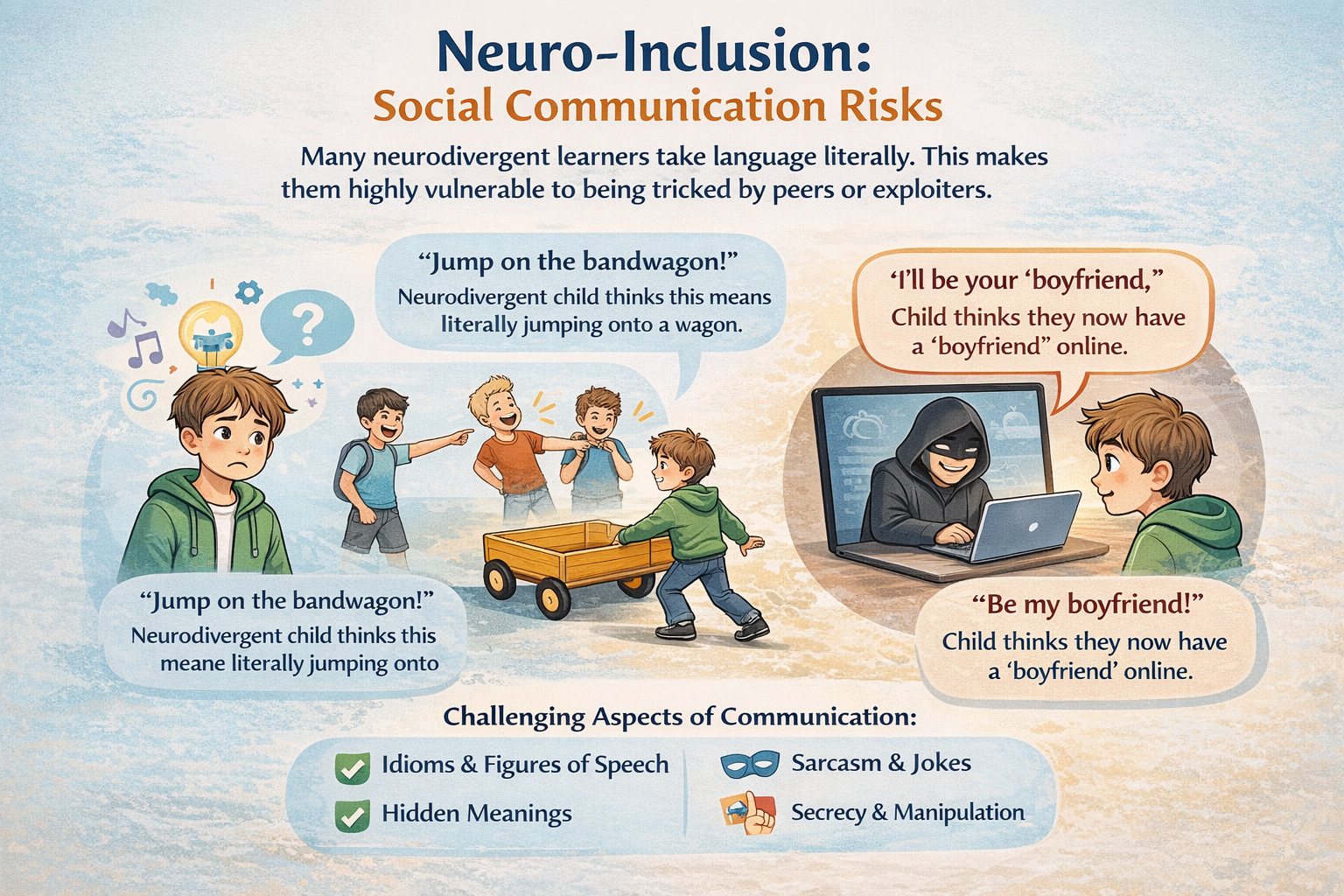
Communication Risk Illustration

The Gold Standard:   Your Professional Conduct

Position of Trust
Maintaining the Boundary:   Professional, not friend.
Statutory Mastery:   Maintain a clear, professional distance from children. You must never “friend” or “follow” a student on personal accounts. This ensures your practice remains beyond reproach and avoids ‘Conduct’ risks.

Allegations:   The Duty to Report

The LADO Pathway:   Conduct concerns.
Professional Application:   If you have a concern about a colleague’s conduct, you must report it immediately. Any allegation against an adult must reach the Local Authority Designated Officer (LADO) within 24 hours.

Your Practice:   Precise Recording of Context

Capturing the Environment:   Details.
Practice Application:   When recording a contextual concern, you must include the “where” and “with whom”. Instead of saying “The child was with friends,” say “The child was observed at the local bus station at 5pm with three older individuals not known to the school.”
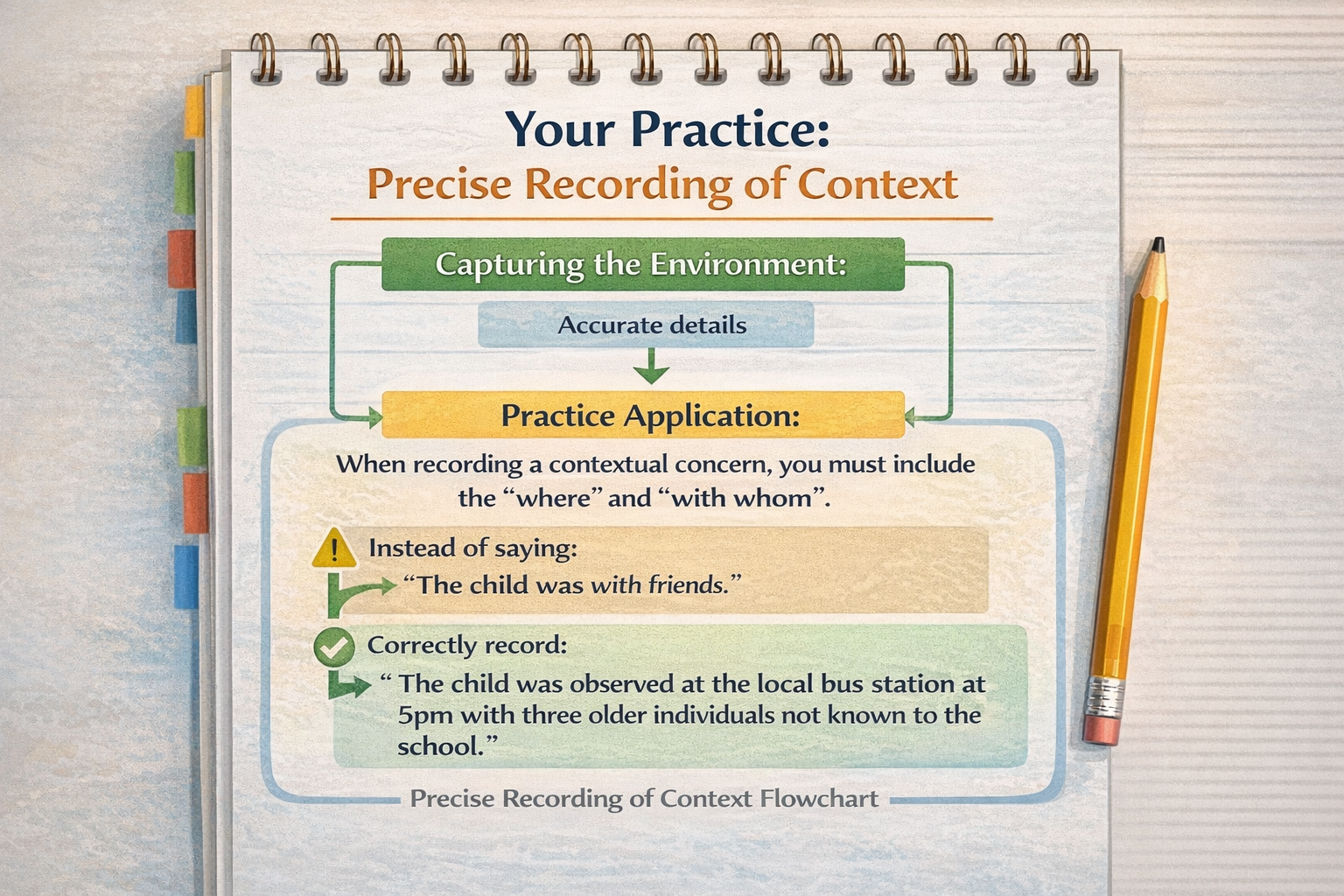
Recording Context Illustration

Pathway to Success:   Scenario 1

1. Contextual Recognition:   A 14-year-old student suddenly arrives at school with a new high-spec smartphone and designer trainers. They claim it was a “gift” from a friend in another town. What is your professional duty?
  • A) To be pleased for the student as they finally have the things they wanted.
  • B) To treat this as a primary indicator of potential criminal exploitation and report it to the DSL.
  • C) To ignore it as it happened outside of school hours.

Pathway to Success:   Scenario 2

2. Child-on-Child Practice:   You overhear a group of students making unwanted sexual comments toward a neurodivergent child. The group claims it is just “banter”. How must you respond?
  • A) To agree that it is just banter if the child isn’t visibly crying.
  • B) To intervene immediately, challenge the behaviour as sexual harassment, and record it as a Child-on-Child safeguarding incident.
  • C) To suggest the neurodivergent student learns how to take a joke better.

Pathway to Success:   Scenario 3

3. Professional Boundaries:   A student sends you a direct message on a social media platform asking for help with a personal problem. What is the correct professional action?
  • A) To reply and help them, as you have a good relationship and they trust you.
  • B) To ignore the message but not report it, to avoid getting the student in trouble.
  • C) To not reply, take a screenshot, and report the contact to your DSL as a breach of professional boundaries.

Module 3 Summary

Professional integrity means protecting children in every context.

Doing it Right:  
Verify your understanding of Contextual Safeguarding, the 4Cs of Online Risk, and Child-on-Child Abuse in your Student Handbook.
Slide 1 of 18