Level 2 Hybrid Safeguarding Children & Young People 2026

Welcome to Level 2 Hybrid Safeguarding

Children &   Young People 2026

World-First Neuro-Informed Training

Welcome to the first neuro-informed safeguarding course for children and young people. We bridge statutory requirements with clinical neuro-inclusive excellence.

Elevated Futures: The first school to be registered as a neuro-inclusive setting built entirely upon the DDP philosophy (Dynamic Development Plan).

Module 1

Foundations and Professional Practice

Professional Leadership in Practice

Mastering the Level 2 statutory requirements to protect children and young people through neuro-inclusive excellence.

Your Learning Intentions

To achieve the expected standard in this module, you must:  

Establish a Safe Professional Boundary.
You must commit to a professional working contract that ensures the identity of every child remains protected and that your practice stays rooted in statutory requirements.
Apply the Statutory Neuro-Inclusive Framework.
You will learn to use the Equality Act 2010 to justify adjusted safeguarding procedures for neurodivergent learners.

Professional Safety Contract:   Confidentiality

Your Legal Duty:   You have a statutory responsibility to protect child and family data.
When you discuss a case study today, you must remove the names of the child, the parents, and the specific setting. Refer only to ‘the individual’ or ‘the context’.
Professional Anonymisation:  
If you are describing a real event to illustrate a threshold, instead of saying “Sarah from my class,” you must say “A seven-year-old child with an Education, Health and Care Plan (EHCP).”

Professional Safety Contract:   Responsibility &   Care

Focus on Statutory Duty:   Your practice must be rooted in law, not anecdote.
Your contributions must stay focused on the Dynamic Development Plan (DDP) and the ‘Keeping Children Safe in Education’ (KCSIE) frameworks to ensure your decisions are objective.
Secondary Trauma &   Self-Regulation:  
Safeguarding leadership is emotionally demanding. You have permission to step out of the room if a case study triggers a distress response. You must manage your own well-being to remain an effective practitioner.

The Equality Act 2010:   The Anticipatory Duty

Disability Law
Proactive Preparation:   You must prepare for neurodivergent needs before a child even arrives.
Under the Act, you cannot claim you “didn’t know” how to communicate with a child during a disclosure. You must have systems ready to accommodate diverse sensory and processing needs.
Reasonable Adjustments for Reporting:  
If your school’s disclosure process is entirely written, you are discriminating against children with processing delays. You must provide visual aids or digital recording options to meet your statutory duty.

Lesson 1.1:   Neuro-Inclusive Vulnerability

The Risk of High Compliance:   Recognising ‘Compliance’ as a red flag.
You must understand that a child who always does as they are told may have been groomed to be ‘compliant’. These children often lack the personal agency to say ‘no’ to an adult in a position of trust.
Identifying ‘Fawning’:  
Fawning is a trauma response where a child tries to please adults to avoid harm. In your practice, you must investigate if a child’s ‘good behaviour’ is actually an attempt to remain safe from an abuser.

Lesson 1.1:   Diagnostic Overshadowing

The Professional Trap:   Attributing indicators of harm to a child’s diagnosis.
When a neurodivergent child’s behaviour spikes, professionals often blame the SEND. You must treat every sudden aggressive or regressive shift as a potential communication of distress or abuse.
Case Application:  
A child with ADHD suddenly stops eating and becomes lethargic. You must not assume it is a ‘medication dip’. You must investigate the home context for domestic instability or neglect as a priority.

Lesson 1.2:   Statutory Pillars &   Leadership

KCSIE 2025/26
The DSL and DDSL Mandate:   Driving the safety culture.
You are responsible for an Ofsted-ready culture. This means you must ensure your DDP is used to evidence the child’s ‘normal’ state. Only when you know what is normal for a child can you catch the subtle changes that indicate harm.

The Statutory Framework:   Core Guidance

KCSIE 2026 Statutory Guidance Working Together to Safeguard Children The Equality Act 2010

The Soham Murders:   Holly and Jessica
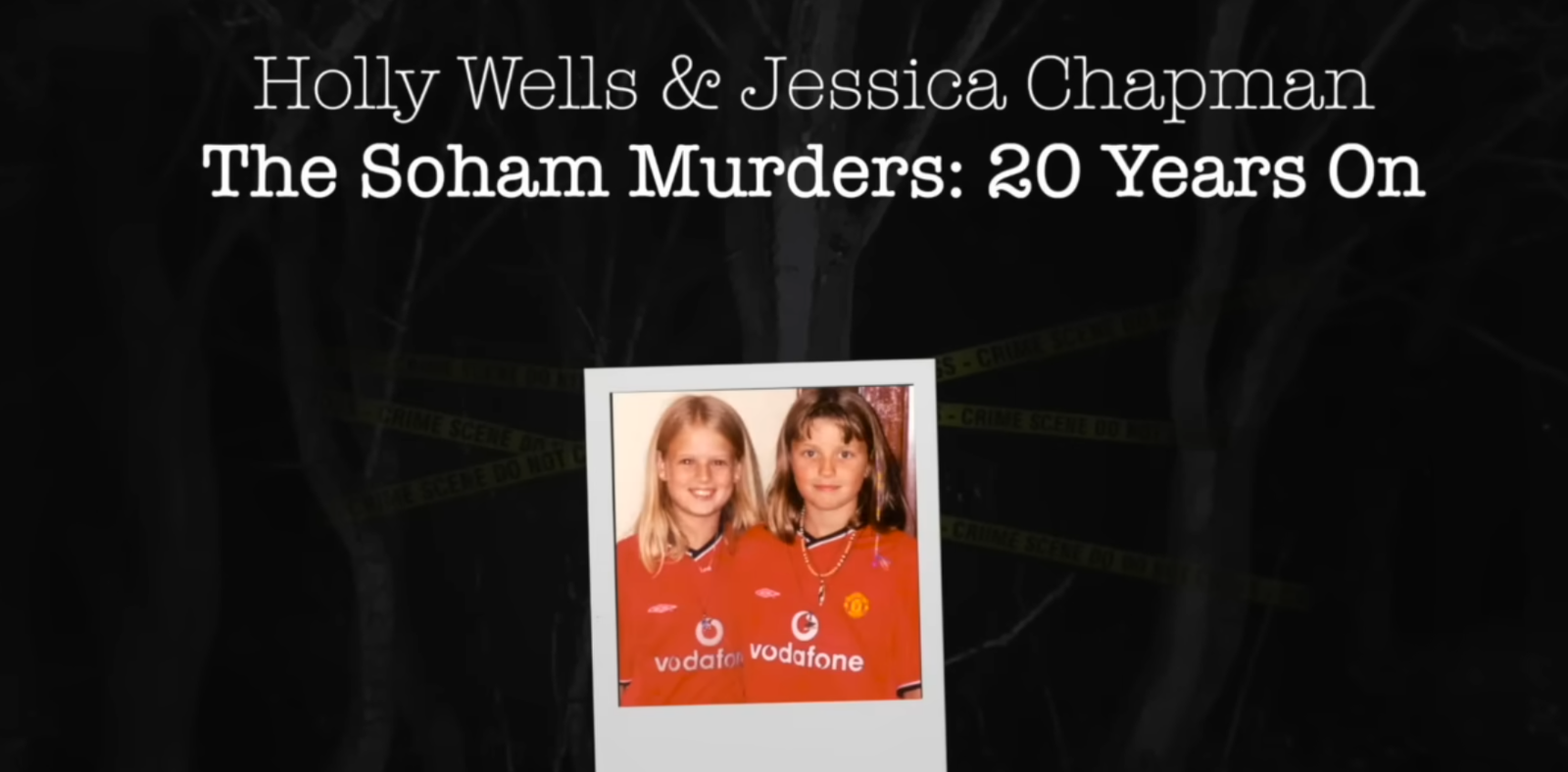
Holly and Jessica - Soham Murders Case Study

Threshold Mastery:   Section 17 Support

The Children Act
Section 17:   The ‘Support’ Threshold.
This threshold is reached when a child’s health or development is likely to be significantly impaired without the provision of services.
Individual Practice Goal:  
You use Section 17 referrals to help families reach the Gold Standard of care. It is a proactive, strengths-based intervention intended to prevent escalation into risk.

Threshold Mastery:   Section 47 Protection

The Children Act
Section 47:   The ‘Protection’ Threshold.
This threshold is triggered when there is reasonable cause to suspect that a child is suffering, or is likely to suffer, Significant Harm.
Professional Action:  
This triggers a mandatory legal investigation by Children’s Social Care. Your role is to provide factual, chronological evidence to support the investigation.

Lesson 1.2:   Identifying Cumulative Harm

Joining the ‘Low-Level’ Dots:   Pattern recognition in neglect.
You must record every minor concern. Individually, a child arriving without a coat is a support issue. Mapped over six months with untreated dental pain and hunger, it is legal evidence of chronic neglect.
Professional Action:  
Use your recording software (e.g., CPOMS) to review the child’s chronology monthly. Your duty is to identify the ‘Support Drift’ before the child’s development is permanently impaired.

The Prevent Duty:   Statutory Obligation

Counter-Terrorism and Security Act 2015
Your Mandatory Duty:   You must have “due regard to the need to prevent people from being drawn into terrorism.”
Professional Conduct:   In the context of extra-familial harm, you must identify signs of radicalisation or the adoption of extremist views. Neurodivergent learners are often targeted for radicalisation because of their desire for a sense of belonging or their literal processing of ideology.
Individual Duty to Report:  
If you observe a child accessing extremist material or expressing views that encourage harm toward others, you must refer through your DSL to the ‘Channel’ programme. Channel is a multi-agency programme providing support to those at risk of radicalisation.

Escalation:   The Professional Duty to Challenge

The Escalation Pathway:   Moving beyond internal reporting.
If you report a concern to your DSL and no action is taken, your legal duty is NOT over. If the child remains at risk, you must contact the Multi-Agency Safeguarding Hub (MASH) or the Police directly.
Challenging the MASH:  
If Social Care close a case that you believe is unsafe, you must follow the ‘Professional Disagreement Protocol’. This involves a formal, written escalation to the Social Work Team Manager.

Professional Accountability:   The LADO

Managing Allegations Against Staff
Managing Adults in a Position of Trust:   Reporting conduct concerns.
Any concern regarding an adult (staff, volunteer, governor) must be reported to the Local Authority Designated Officer (LADO) within 24 hours.
Safe Practice Example:  
If you see a colleague using an unauthorised physical intervention on a neurodivergent child, you must not ‘investigate’ it yourself. You must report it to the Headteacher and the LADO immediately.

Pathway to Success:   Scenario 1

1. Statutory Justification:   Under the Equality Act 2010, what is your “Anticipatory Duty” regarding a neurodivergent child who needs to report a concern?
  • A) To wait for the child to find a way to tell you themselves.
  • B) To have visual or digital reporting tools ready before the child ever needs them.
  • C) To ask the parents to translate for the child if a concern arises.

Pathway to Success:   Scenario 2

2. Threshold Application:   You identify that a family is struggling to provide adequate food and clothing, but there is no evidence of “significant harm”. Which threshold is met?
  • A) Section 17:   Child in Need.
  • B) Section 47:   Child Protection.
  • C) Universal Support.

Pathway to Success:   Scenario 3

3. Escalation Logic:   You report a serious concern to your DSL, but after 48 hours no action is taken and the child remains at risk. What is your legal duty?
  • A) To trust the DSL’s judgement and wait for them to act.
  • B) To follow the Escalation Policy and contact the MASH or Police directly.
  • C) To record the concern again and wait another week for a response.

Module 1 Summary

Excellence in safeguarding starts with your consistent practice.

Next Steps:  
Verify your answers in your Student Handbook and log into the LearnDash portal to complete the official Module 1 Assessment.

Module 2

Recognising Abuse, Neglect and Vulnerability

Professional Recognition in Practice

Mastering the ability to identify indicators of harm while maintaining a consistent, neuro-inclusive lens through real-world application.

Your Learning Intentions

In this module, you must develop the professional skill to:  

Identify the Four Main Categories of Abuse.
You must be able to recognise the physical, emotional, and behavioural indicators for Physical Abuse, Emotional Abuse, Sexual Abuse, and Neglect.
Apply a Neuro-Inclusive Safeguarding Lens.
You must learn to distinguish between neurodivergent traits and safeguarding indicators through the use of specific case study analysis.

Statutory Categories:   Foundations of Recognition
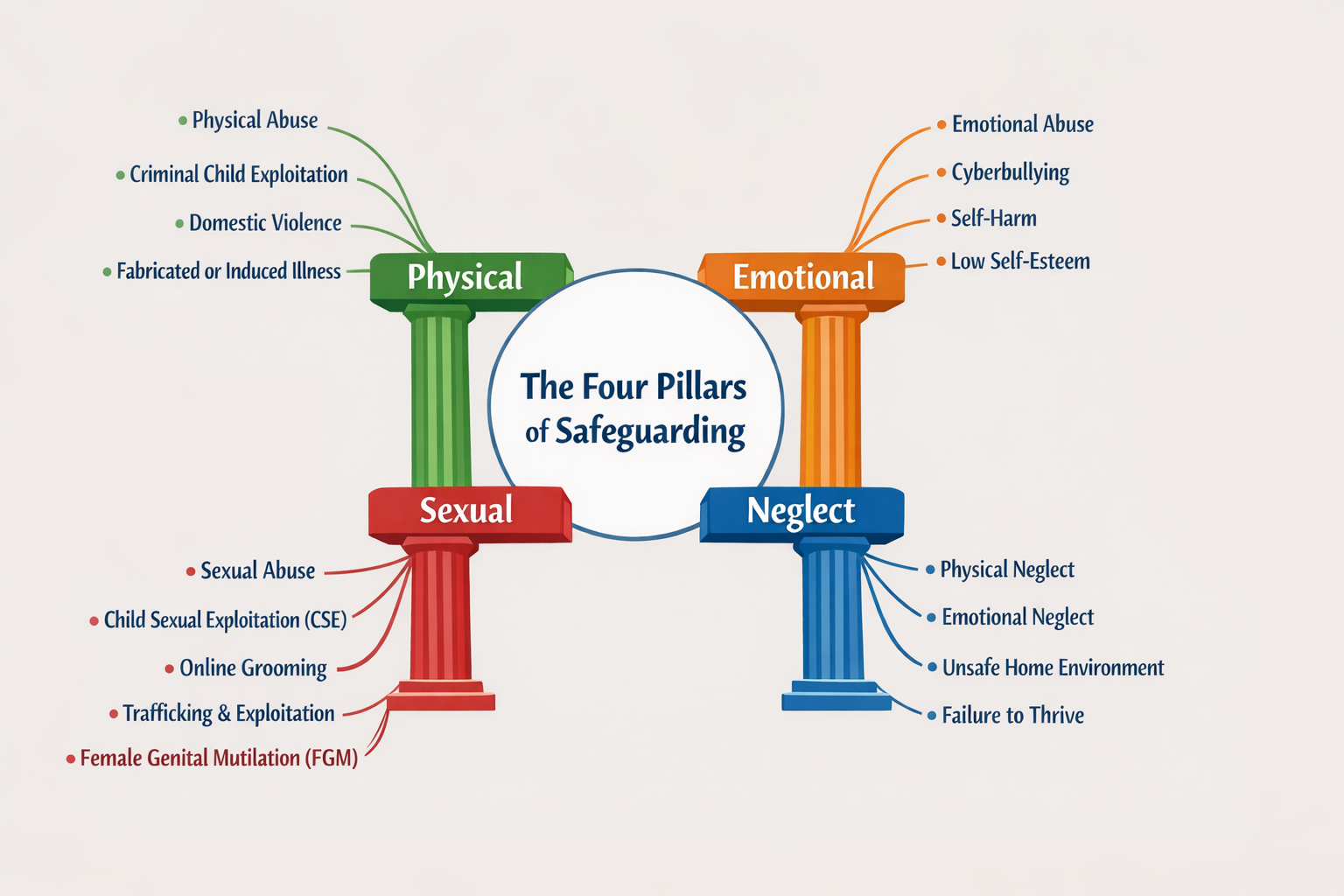
Working Together 2023
The Duty of Vigilance:   Consistency.
You must understand that abuse is often a combination of factors. While we categorise harm into four areas, you must look for the “interconnectivity” of indicators to form a professional judgement.
Safeguarding Categories Infographic © Lane Anthony

Your Practice:   Recognising Physical Abuse

Non-Accidental Injury:   Spotting the indicators.
You must look for bruising in “non-mobile” areas or soft tissue (e.g., ears, neck, cheeks). You must also identify “patterned” injuries that resemble an object or a handprint.
Behavioural Shifts:   Flinching and Avoidance.
Observe if a child becomes flinchy when approached or if they consistently wear clothes to hide their body, even in warm weather. These are non-verbal indicators requiring your professional inquiry.

Case Study:   Sara Sharif (Physical Abuse)

Sara Sharif © Lane Anthony

Professional Analysis:   Sara Sharif suffered extensive physical abuse that was masked by a narrative of “unruliness” and domestic secrecy.

In your practice, you must be alert to multiple injuries at different stages of healing. For neurodivergent learners, injuries are often dismissed as “self-harm” or “meltdowns.” You must apply professional curiosity to every mark.

Your Practice:   Recognising Emotional Abuse

The Omission of Warmth:   Persistent ill-treatment.
Emotional abuse is the persistent maltreatment of a child causing adverse effects on emotional development. You must identify if a child is being consistently belittled, scapegoated, or ignored.
Professional Observation:   Developmental regression.
Take note if a child begins to lose previously mastered skills or displays extreme “attention-avoiding” behaviours, particularly in the presence of specific caregivers.

Case Study:   Arthur Labinjo-Hughes (Emotional Abuse)

Arthur Labinjo-Hughes © Lane Anthony

Professional Analysis:   Arthur was subjected to psychological torture, including isolation and being forced to stand for long periods.

You must look for signs of “fading away.” Emotional abuse often leaves no physical scars but manifests as a total loss of joy and engagement. Arthur’s cries for help were heard but not consistently acted upon by professionals.

Your Practice:   Recognising Sexual Abuse

Behavioural Indicators:   Inappropriate knowledge.
Identify if a child displays sexual knowledge or behaviour beyond their developmental age. Be alert to sudden changes in mood or the possession of unexplained gifts or money.
Grooming:   Isolating the individual.
Grooming builds a relationship to lower inhibitions. You must look for adults or older peers who isolate the child or “favour” them with excessive, inappropriate attention.

Case Study:   Vincent Chan (Sexual Abuse & Grooming)

Vincent Chan © Lane Anthony

Professional Analysis:   Exploitation and abuse through trust by a nursery practitioner.

Sexual abuse often involves “position of trust” exploitation. In your practice, you must never assume that a “friendly” adult is safe. You must monitor adult-child boundaries with absolute consistency. If an adult is frequently alone with a specific learner without a valid reason, you must report it.

Your Practice:   Recognising Neglect

The Basic Needs Checklist:   Consistency.
Record instances of persistent poor hygiene, untreated medical issues, inadequate clothing and the parent’s inability to safeguard the child from all harm . Neglect is chronic and happens slowly; your chronology is the only way to prove it.
Statutory Attendance:   Persistent Absence.
Absence below 90% is a key safeguarding indicator. You must treat school refusal or absence as a potential sign of educational neglect or hidden domestic trauma.

Case Study:   Baby Victoria (Chronic Neglect)

Baby Victoria Case Study Image © Lane Anthony

Professional Analysis:   Baby Victoria was born into a context of extreme transience and neglect, leading to fatal consequences.

You must understand that neglect is an omission of care. When parents are “off-grid” or avoid medical professionals, the risk to the child is extreme. Your duty is to identify and report the very first omission of a basic need.

Neuro-Inclusive Lens:   The Masking Risk

Hidden Vulnerability:   Silenced distress.
Neurodivergent children may “mask” their distress to fit in. A child appearing “fine” or “compliant” may be exerting energy to hide abuse. Fawning is a trauma response where a child appeases adults to stay safe.

Neuro-Inclusive Lens:   Avoiding the Trap

Diagnostic Overshadowing:   Correcting perspective.
Never assume a change in behaviour is “just the autism.” If a child’s sensory rocking increases or they become aggressive, treat it as potential communication of distress until ruled out.

Contextual Safeguarding:   Beyond the Home

Beyond the Family
Peer and Community Risk:  
Harm happens in the community, online, or in peer groups. Look for unexplained associations or sudden possession of high-value items. Neurodivergent learners are targeted for their desire to belong.

Using the DDP for Safeguarding Excellence

Identifying the Deviation:  
Use the Dynamic Development Plan (DDP) to establish the child’s “normal” sensory and behavioural baseline. When DDP data shows a drop in engagement, you must ask: “What has changed in their life?”

Pathway to Success:   Scenario 1

1. Recognition Skills:   You notice a neurodivergent learner has become unusually compliant and “helpful” toward a specific adult. What should you consider?
  • A) That the child has finally “settled down.”
  • B) That this is a potential “Fawn” trauma response requiring investigation into grooming.
  • C) That the adult has found a new interest to engage the child.

Pathway to Success:   Scenario 2

2. Avoiding the Trap:   An autistic child starts displaying new self-injurious behaviour. What is your first professional action?
  • A) Update the DDP to include a new “behavioural symptom.”
  • B) Treat it as a safeguarding indicator and investigate for physical harm or distress.
  • C) Ignore it unless they physically bleed.

Pathway to Success:   Scenario 3

3. Identifying Neglect:   A child arrives three times in one week with dirty hair and a strong body odour. What is your next step?
  • A) Give the child a wash quietly.
  • B) Check the chronology for a pattern and report a concern regarding neglect to the DSL.
  • C) Assume the parents are just “busy.”

Module 2 Summary

Recognition is the first step in the safeguarding pathway.

Doing it Right:  
Verify your recognition skills in your Student Handbook and log into the LearnDash portal to complete the official Module 2 Assessment.

Module 3

Professional Conduct and Contextual Safeguarding

Professional Integrity in Practice

Mastering the standard of individual conduct and identifying risks that exist beyond the family home.

Your Learning Intentions

In this module, you must develop the professional skill to:  

Understand Contextual Safeguarding.
You must be able to recognise that harm happens in many environments including online, in the community, and within peer groups.
Maintain the Gold Standard of Conduct.
You must ensure your individual professional boundaries are consistent and that you can identify and challenge Child-on-Child Abuse.

Contextual Safeguarding:   Widening the Lens

KCSIE 2025/26 Framework
Beyond the Front Door:   Risks in the community.
Statutory Application:   Contextual Safeguarding recognises that as children grow, they spend more time in environments where their parents or caregivers have little influence. You must be alert to risks in parks, shopping centres, public transport, and the digital world.

Your Practice:   Recognising Extra-Familial Harm

Identifying External Threats:   Community-based risk.
Professional Mastery:   You must observe the child’s associations. If a learner suddenly starts spending time with significantly older individuals or is frequently absent from school without a valid reason, you must investigate this as a potential safeguarding concern.
Exploitation Indicators:   Unexplained changes.
Practice Application:   You must take note if a child suddenly has new clothes, expensive trainers, or multiple mobile phones that they cannot explain. These are primary indicators of criminal or sexual exploitation.

Introduction:   County Lines

County Lines Introduction © Lane Anthony

Professional Context:   County Lines is a form of criminal exploitation where urban gangs use children to transport and sell drugs in suburban or rural areas.

In your practice, you must recognise that “choice” is not a factor. Children are coerced through debt-bondage, threats, and violence. Neurodivergent learners are often recruited for their desire for loyalty and structure.

Criminal Exploitation:   Recruitment &   Duty

The Recruitment Process:   Targeting vulnerability.
Professional Application:   Criminal groups often target neurodivergent learners because of their desire for social inclusion or their difficulty in reading the intentions of others. You must be alert to children being used to transport drugs or money across “lines”.
The Individual Duty:   Reporting the pattern.
Practice Mastery:   You must record any mention of the child being “debt bonded” or forced to perform “favours” for others. This is a severe form of abuse that requires immediate referral to your DSL.

Your Practice:   Challenging Child-on-Child Abuse

KCSIE Statutory Update
The Terminology Shift: The DfE has replaced the term “peer-on-peer” with Child-on-Child Abuse.
The Logic: Calling it “peer” abuse risk normalising harm as social conflict between equals. The term “Child-on-Child” makes it clear that this is a serious safeguarding matter requiring a formal intervention.
Abuse, Not “Banter”:   Professional challenge.
Professional Application:   You must never dismiss harmful sexual behaviour or physical violence between children as “just a joke.” Child-on-child abuse includes sexual harassment and the non-consensual sharing of images.

The Digital Context:   Online Safeguarding

The Digital Front Door:   24/7 vulnerability.
Professional Mastery:   You must understand that a child’s digital life is real life. Online grooming, cyber-bullying, and exposure to harmful content are major safeguarding risks. You must be curious about the child’s digital footprint and their online interactions.

Statutory Framework:   The 4Cs of Online Risk

Categorising Digital Harm:  
  • Content:   Exposure to inappropriate, harmful, or illegal material.
  • Contact:   Subject to harmful interaction (e.g. grooming, exploitation).
  • Conduct:   Personal behaviour that causes harm (e.g. sharing ‘nudes’).
  • Commerce:   Risks such as online gambling, phishing, or scams.

Source: KCSIE Statutory Guidance.

The Digital Context:   Generative AI & Deepfakes

Emerging Digital Risk
AI-Generated Harm: The rise of ‘Deepfakes’ and synthetic media.
Statutory Application:   Under Child-on-Child Abuse guidance, the creation or sharing of non-consensual AI-generated “nudes” or manipulated imagery is a serious safeguarding breach and potentially a criminal offence. You must teach learners that “seeing is no longer believing.”
The Neuro-Inclusive Risk: Literal processing and AI.
Professional Mastery:   Neurodivergent learners may struggle to distinguish between a human and an AI chatbot. There is a risk of “Digital Grooming” where AI is used to simulate friendship or empathy to extract personal information or radicalise the individual. Your practice must include checking if a child’s “online friend” is actually a bot.

Case Study:   Molly Russell

Molly Russell Case Study © Lane Anthony

Professional Analysis:   Molly Russell’s death highlighted the extreme danger of algorithmic exposure to self-harm and depressive content (Content Risk).

You must understand that “Online Safeguarding” is not just about strangers; it is about content. In your practice, you must monitor if a learner’s online search history or social media feeds are reinforcing harmful thoughts or behaviours.

Neuro-Inclusion:   Social Communication Risks
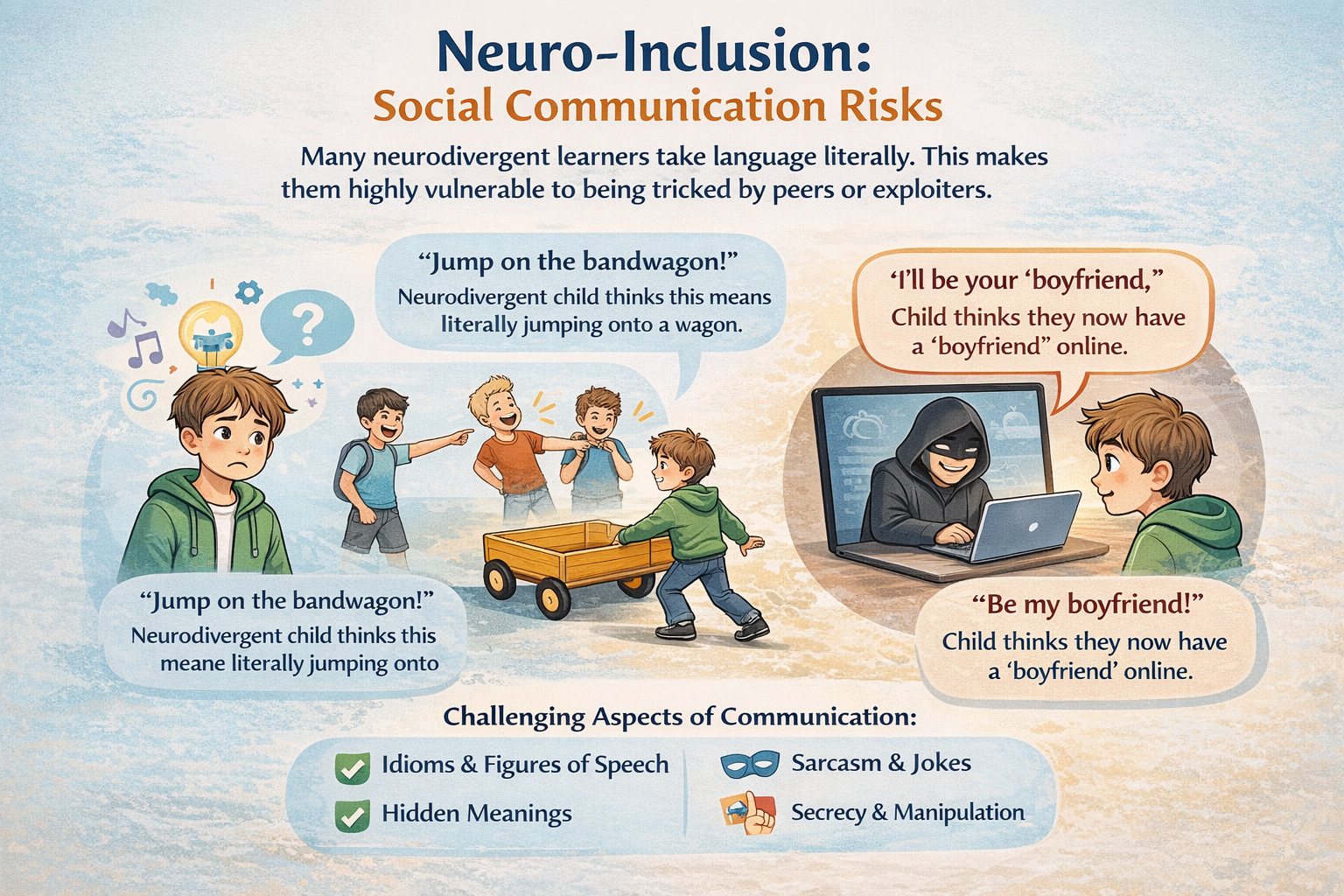
Literal Interpretation:   Misleading risk.
Practice Application:   Many neurodivergent learners take language literally. This makes them highly vulnerable to being tricked by peers or exploiters. You must teach and model the “Safe Professional Boundary” so they understand safety.
Communication Risk Illustration © Lane Anthony

The Gold Standard:   Your Professional Conduct

Position of Trust
Maintaining the Boundary:   You are the professional, not the friend.
Statutory Mastery:   You must maintain a clear, professional distance from the children in your care. This includes your social media presence. You must never “friend” or “follow” a student on your personal accounts, as this breaches your professional code of conduct.

Allegations:   The Duty to Report

The LADO Pathway:   Handling concerns about adults.
Professional Application:   If you have a concern about a colleague’s conduct, you must report it immediately. Any allegation against an adult must reach the Local Authority Designated Officer (LADO) within 24 hours.

Your Practice:   Precise Recording of Context
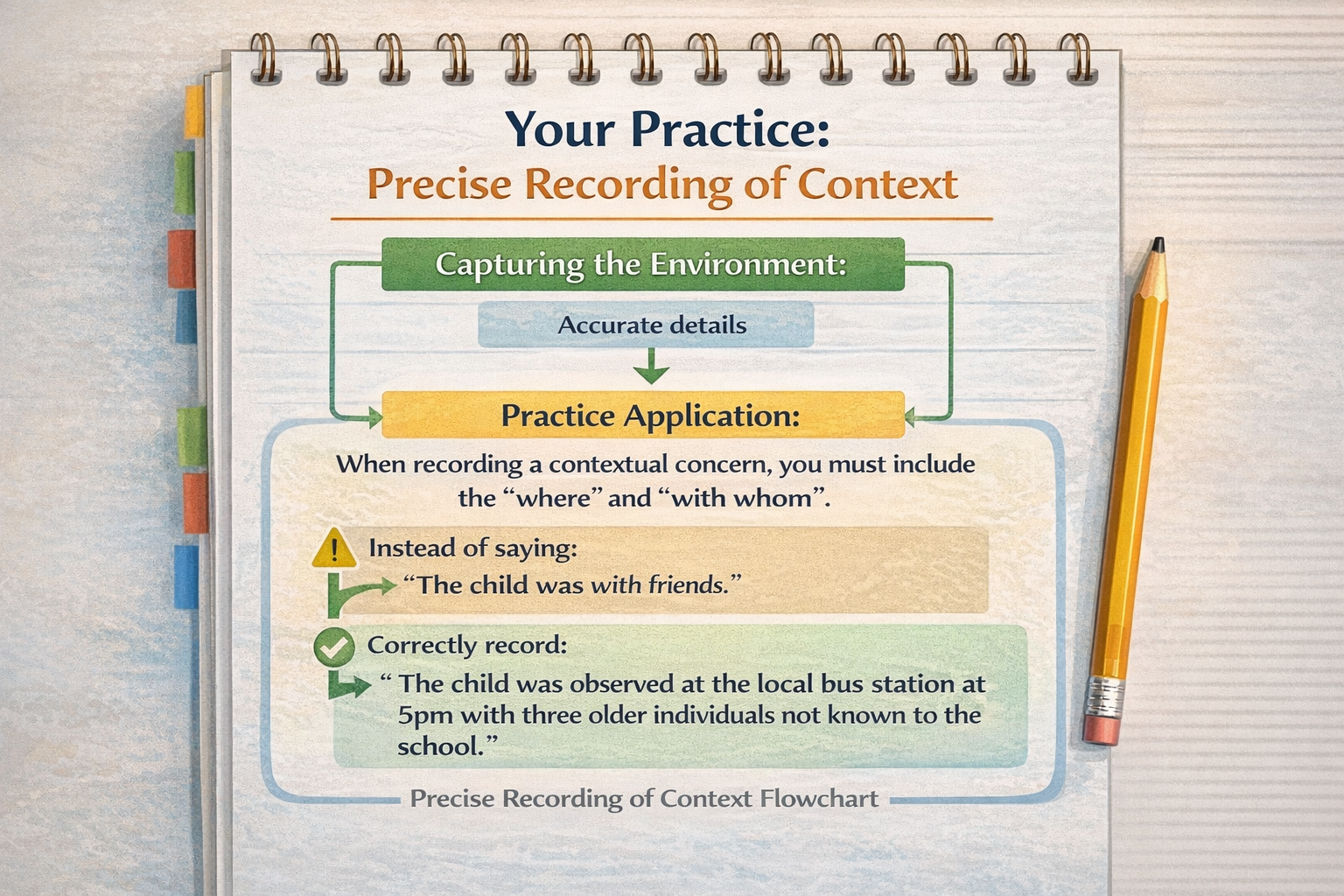
Capturing the Environment:   Details.
Practice Application:   When recording a contextual concern, you must include the “where” and “with whom”. Instead of saying “The child was with friends,” say “The child was observed at the local bus station at 5pm with three older individuals not known to the school.”
Recording Context Illustration © Lane Anthony

Pathway to Success:   Scenario 1

1. Contextual Recognition:   A 14-year-old student suddenly arrives at school with a new high-spec smartphone and designer trainers. They claim it was a “gift” from a friend in another town. What is your professional duty?
  • A) To be pleased for the student as they finally have the things they wanted.
  • B) To treat this as a primary indicator of potential criminal exploitation and report it to the DSL.
  • C) To ignore it as it happened outside of school hours.

Pathway to Success:   Scenario 2

2. Child-on-Child Practice:   You overhear a group of students making unwanted sexual comments toward a neurodivergent child. The group claims it is just “banter”. How must you respond?
  • A) To agree that it is just banter if the child isn’t visibly crying.
  • B) To intervene immediately, challenge the behaviour as sexual harassment, and record it as a Child-on-Child safeguarding incident.
  • C) To suggest the neurodivergent student learns how to take a joke better.

Pathway to Success:   Scenario 3

3. Professional Boundaries:   A student sends you a direct message on a social media platform asking for help with a personal problem. What is the correct professional action?
  • A) To reply and help them, as you have a good relationship and they trust you.
  • B) To ignore the message but not report it, to avoid getting the student in trouble.
  • C) To not reply, take a screenshot, and report the contact to your DSL as a breach of professional boundaries.

Module 3 Summary

Professional integrity means protecting children in every context.

Doing it Right:  
Verify your understanding of Contextual Safeguarding, the 4Cs of Online Risk, and Child-on-Child Abuse in your Student Handbook.

Module 4

Responding and Recording (The Mechanics)

Professional Mechanics:   Doing it Right

Mastering the precise individual actions required to receive a disclosure and record concerns to a legally defensible standard.

Your Learning Intentions

In this module, you must develop the professional skill to:  

Master Disclosure Reception.
You must learn the practical “Do’s and Don’ts” of receiving information from a child, ensuring you provide a safe, non-investigative environment.
Master Factual Recording.
You must learn to differentiate between fact and opinion, producing chronological records that evidence patterns of harm with precision.

Your Practice:   The State of Mind

Professional Presence:   Calm and receptive.
Professional Mastery:   When a child begins to disclose harm, your primary duty is to remain calm. Children, particularly neurodivergent learners, are highly sensitive to adult emotional shifts. If you show shock, anger, or distress, the child may stop talking to protect you.

Your Practice:   Creating a Safe Space

Environmental Adjustments:   Removing barriers.
Practice Application:   You must ensure the environment supports the child’s sensory needs. If a disclosure happens in a noisy corridor, move to a quiet space but remain visible to other staff. For neurodivergent learners, the “Safe Space” may include access to their preferred regulation tools.

Disclosure Mastery:   The Action List

Active Listening:   Giving the child time.
Practice Application:   You must listen without interrupting. Allow for long pauses; neurodivergent learners often require extra processing time to find the words or symbols they need. Use minimal encouragers like “I’m listening” or a simple nod.
Affirmation:   Reassurance without promises.
Practice Mastery:   You must tell the child: “You have done the right thing by telling me.” This validates their courage. However, you must be consistent in explaining that you cannot keep it a secret because your job is to keep them safe.

Disclosure Mastery:   Avoiding the Traps

Non-Investigative Reception:   Receiving, not interviewing.
Statutory Application:   You must NOT ask leading questions such as “Did your dad hit you?” or “Was it your brother?”. These questions contaminate the child’s evidence. You must only use open prompts like “Tell me more about that” or “And then what happened?”.
Professional Boundaries:   Neutrality.
Professional Mastery:   You must NOT express your own opinion about the alleged abuser. Even if you are shocked, your face and voice must remain neutral to ensure the child feels safe to continue.

The Mechanics of Memory:   Immediacy

The “Golden Hour”:   Preservation of Evidence.
Practice Application:   The mechanics of recording begin the moment the child leaves the room. You must record the details immediately. Human memory degrades rapidly; delays lead to the loss of specific quotes, nuances in body language, and precise timings that are critical for legal thresholds.

Your Practice:   The Gold Standard of Recording

KCSIE 2026 Mandate
Precision in Evidence:   Legally sound records.
Statutory Application:   Your record may be used in a court of law or a multi-agency conference. You have a duty to ensure it is accurate, dated, and signed. You must complete the record as soon as possible after the event while the details are fresh.

Recording Mechanics:   Fact vs Opinion

Separating Truth from Interpretation:  
Professional Mastery:   You must only record what you saw and what you heard. Do not use adjectives that interpret the child’s state of mind unless you are quoting them. If you must include a professional opinion, it must be clearly labeled as such and based on observable evidence.

Factual Precision:   The Accuracy Test

Observable Evidence:   Writing for the threshold.
Practice Application:   Instead of writing “The child was aggressive,” you must write “The child threw two chairs and shouted ‘Get away from me'”. Instead of “The child seemed neglected,” write “The child’s shirt was visibly soiled and there was an odour of urine.”

Recording Neurodivergent Distress

Describing Communication:  
Practice Application:   When recording concerns for a neurodivergent learner, you must be specific about their regulation. Use the Dynamic Development Plan (DDP) to contrast their current behaviour with their “normal” baseline. Record symbols used or specific non-verbal cues exactly.

Chronologies:   Identifying Pattern and Drift

The Cumulative Harm Log:   Joining the dots.
Statutory Application:   Neglect and Emotional Abuse are often identified through a chronology. You must record every “minor” concern. On their own, these are support issues; together, they are a safeguarding crisis that justifies a specialist referral.

Anchoring Practice:   The DDP Link

Evidencing the Deviation:  
Practice Application:   In your safeguarding report, you must reference the DDP to prove the significance of a change. For example:   “The child’s DDP shows consistent engagement in sensory breaks; this week, they have refused all contact and remained under a desk for 3 hours.”

Pathway to Success:   Scenario 1

1. Disclosure Mastery:   A child stops mid-disclosure and asks, “Do you promise not to tell my mum?”. How must you respond to be consistent with the Gold Standard?
  • A) “I promise, it will be our little secret.”
  • B) “I can’t promise that, but I can promise that I will listen and do my best to keep you safe.”
  • C) “I have to tell everyone, even if you don’t want me to.”

Pathway to Success:   Scenario 2

2. Factual Recording:   Which of these entries meets the professional standard for accuracy in a safeguarding record?
  • A) “The child was very sad and their parents clearly haven’t cared for them today.”
  • B) “The child arrived at 08:55 crying. Their hair was visibly matted and there was an odour of urine from their clothing.”
  • C) “The child seemed neglected and was having a difficult morning.”

Pathway to Success:   Scenario 3

3. Neuro-Inclusive Practice:   You are receiving a disclosure from a non-verbal student using symbols. They point repeatedly at ‘SAD’ and ‘HOUSE’. What is your next action?
  • A) Redirect them to their next lesson.
  • B) Use open prompts and visual aids to help them describe the concern and record the interaction exactly.
  • C) Call the parents immediately and ask them to explain.

Module 4 Summary

The precision of your record is the strength of the child’s protection.

Doing it Right:  
Verify your disclosure and recording techniques in your Student Handbook and log into the LearnDash portal to complete the official Module 4 Mastery Check.

Module 5

Thresholds and Multi-Agency Working

Professional Collaboration in Practice

Navigating the statutory levels of need and mastering your duty to challenge decisions through multi-agency pathways.

Your Learning Intentions

In this module, you must develop the professional skill to:  

Categorise the Level of Need.
You must be able to justify the distinction between Section 17 (Support) and Section 47 (Protection) based on the evidence you have recorded.
Execute the Duty to Challenge.
You must learn the formal protocols for professional disagreement to ensure that systemic delays never compromise a child’s safety.

Introduction:   The Threshold Windscreen
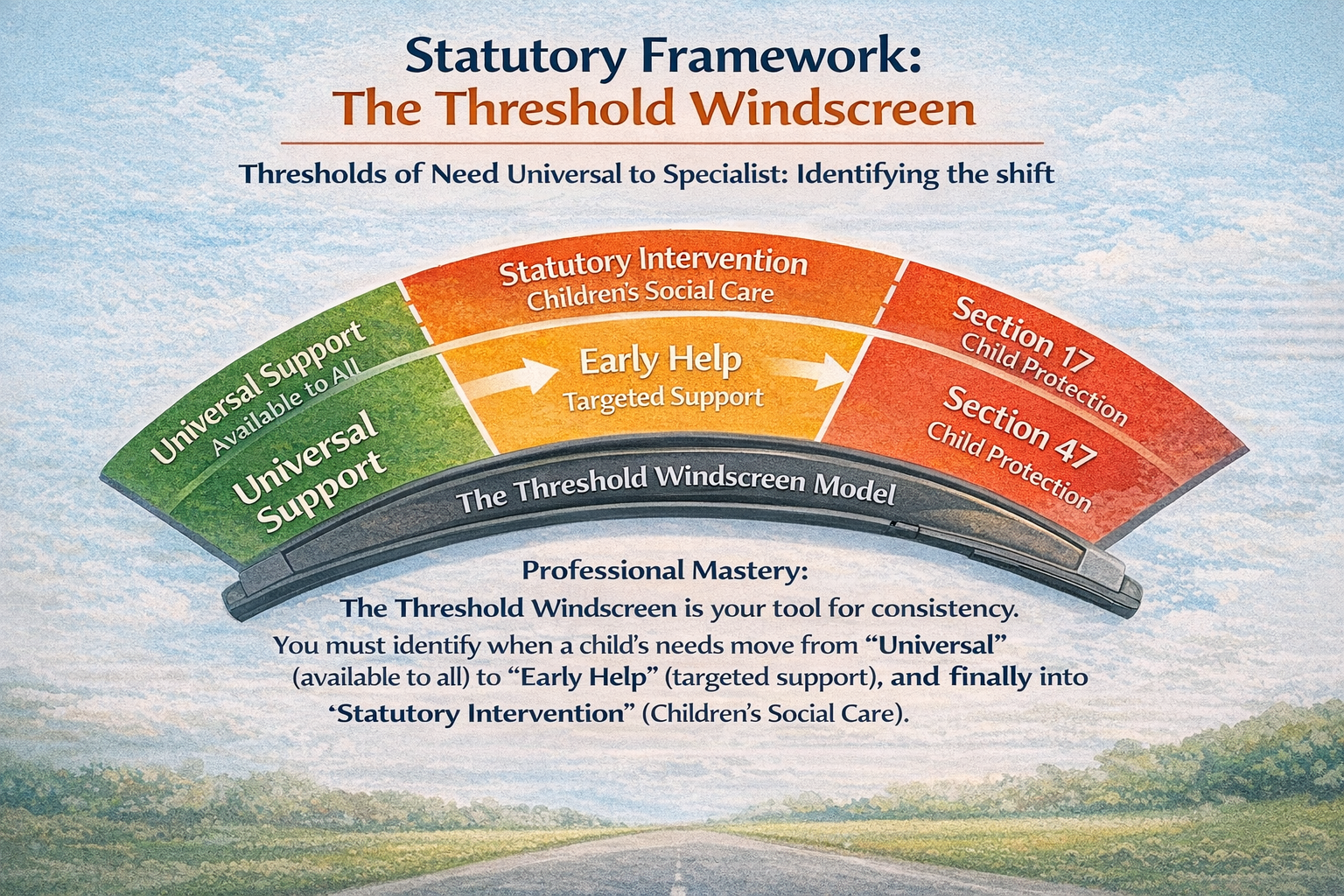
Threshold Windscreen Introduction © Lane Anthony

Statutory Concept:   The Threshold Windscreen is a visual model used by all agencies to ensure consistency when determining the level of support or protection a child requires.

In your practice, you must use this model to identify when a child’s needs have escalated beyond ‘Early Help’ and require statutory intervention from Children’s Social Care.

Statutory Framework:   The Windscreen Levels

Thresholds of Need
Universal to Specialist:   Identifying the shift.
Professional Mastery:   Level 1 is Universal (all children). Level 2 is Early Help (targeted). Level 3 is Section 17 (Statutory Support). Level 4 is Section 47 (Child Protection). Your individual duty is to evidence the move between these tiers with factual recording.

Your Practice:   Section 17 (Child in Need)

Children Act 1989
The Support Threshold:   Proactive intervention.
Statutory Application:   A child is ‘in need’ if they require services to maintain a reasonable standard of health or development. You use Section 17 when a family is struggling but the child is not in immediate danger of significant harm.

Your Practice:   Section 47 (Child Protection)

Children Act 1989
The Protection Threshold:   Immediate risk.
Statutory Application:   Section 47 is triggered when there is reasonable cause to suspect that a child is suffering, or is likely to suffer, Significant Harm. This is a mandatory investigation threshold.

Multi-Agency Working:   The MASH

The Information Gateway:   Collaborative decision making.
Professional Mastery:   The MASH brings together professionals from health, police, and social care. When you make a referral, the MASH uses shared data to decide thresholds. Prepare to share your DDP data to provide the ‘school perspective’.

Statutory Duty:   Working Together

Working Together 2023 Guidance
The Duty of Cooperation:   Breaking siloes.
Statutory Application:   Safeguarding is not a solo task. You have a legal duty to cooperate with other agencies. This includes attending meetings and providing factual reports based on your setting’s observations.
Working Together 2023 Document © Lane Anthony

Your Practice:   The Team Around the Child (TAC)

The Support Network:   Local collaboration.
Practice Application:   A TAC meeting is a community-level response. You must use these meetings to share the child’s strengths and advocate for the “Reasonable Adjustments” required by the Equality Act 2010.

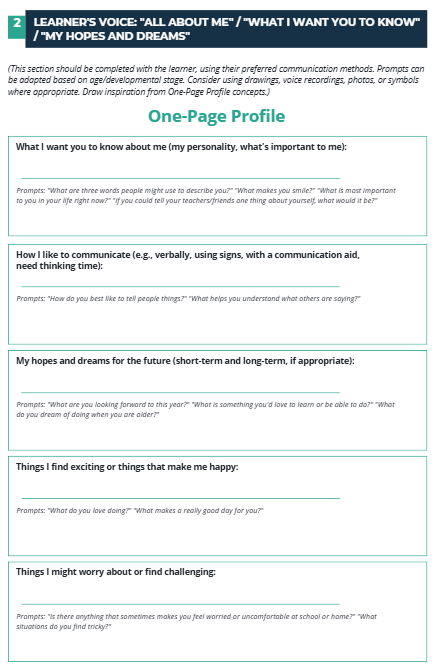
The DDP Profile:   All about Me!

Individual Advocacy:   The Dynamic Development Plan (DDP) ensures the child’s voice and sensory needs are central to multi-agency planning.
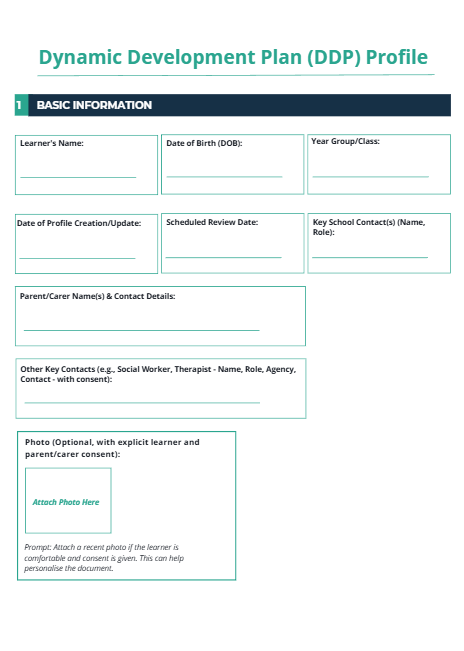
DDP Page 1 © Lane Anthony
DDP Page 2 © Lane Anthony

Professional Accountability:   The Duty to Challenge

When the System Fails:   Courage.
Professional Mastery:   If you report a concern and it is closed, but you still have evidence of risk, your duty is NOT over. You must have the courage to professionally disagree through formal channels.

The Escalation Pathway:   Disagreement Protocol
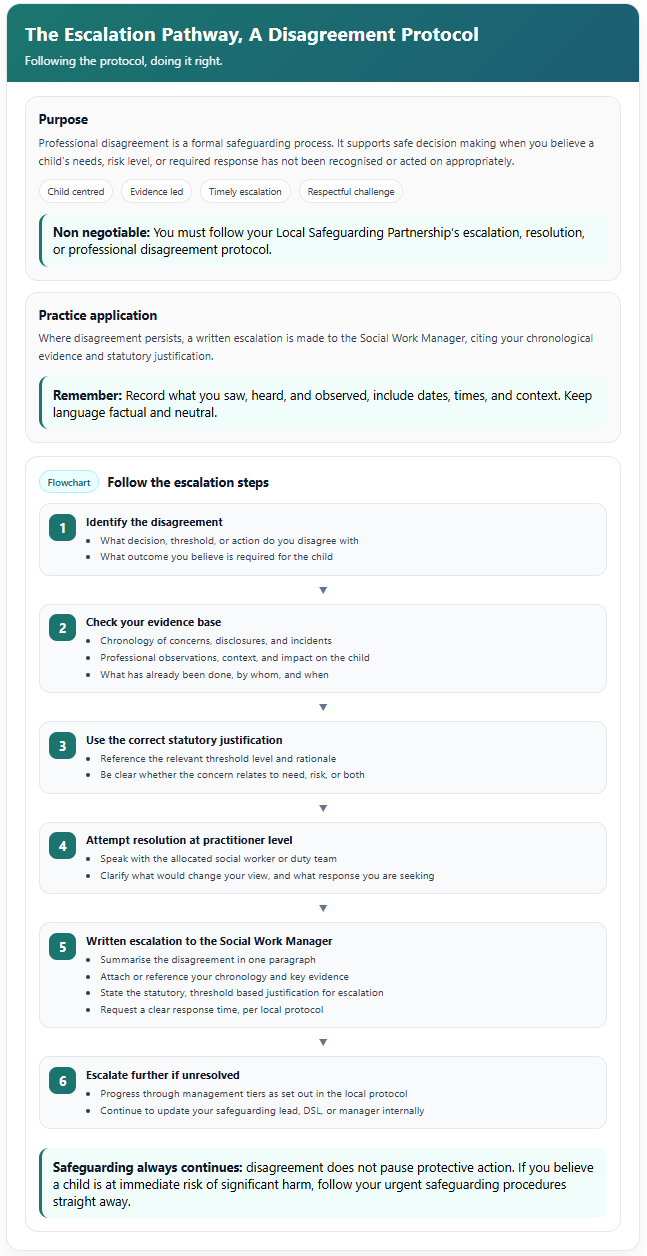
Following the Protocol:   Doing it right.
Practice Application:   Professional disagreement is a formal process. You must follow the ‘Disagreement Protocol’. This involves a written escalation to the Social Work Manager, citing your evidence.
Disagreement Protocol Flowchart © Lane Anthony

Your Practice:   Advocacy for the SEND Learner

Ensuring parity in the system.
Practice Mastery:   In multi-agency meetings, you are the expert on the child’s communication. Ensure that the child’s neurodivergence is not used as a reason to dismiss their lived experience. Remind the group of the “Anticipatory Duty” under the Equality Act.

Professional Goal:   Consistency in Action

The Gold Standard:   Predictable protection.
Ensure that your referrals are always factual and evidenced. Factual referrals are more likely to meet the correct threshold first time, reducing the need for escalation.

Pathway to Success:   Scenario 1

1. Threshold Mastery:   You identify that a child is living in a home with severe domestic violence and there is an immediate risk of physical harm. Which statutory threshold must you advocate for?
  • A) Section 17:   Child in Need support.
  • B) Section 47:   Child Protection investigation.
  • C) Early Help targeted services.

Pathway to Success:   Scenario 2

2. The MASH Pathway:   You make a referral to the MASH. What information should you provide from your individual practice?
  • A) Your personal opinion on the parents’ character.
  • B) A factual chronology of concerns and the child’s baseline from the DDP.
  • C) A suggestion for which school the child should move to.

Pathway to Success:   Scenario 3

3. Escalation Duty:   You report a concern about neglect, but the case is closed. You observe the child’s hygiene continues to decline. What is your professional duty?
  • A) To accept the decision.
  • B) To trigger the Disagreement Protocol and escalate to the Social Work Manager.
  • C) To wait for another agency to notice.

Module 5 Summary

The safety of the child depends on your courage to navigate the system.

Professional Mastery:  
Verify your understanding of thresholds and the Disagreement Protocol in your Student Handbook before attempting the assessment.

Module 6

Safer Culture and Individual Accountability

Professional Accountability:   The Final Pillar

Ensuring individual transparency and mastering procedures for managing concerns about adults in trust.

Your Learning Intentions

In this final module, you must develop the professional skill to:  

Manage Allegations Against Staff.
Understand the statutory role of the LADO and your individual duty to report concerns within 24 hours.
Cultivate a Safer Culture.
Learn the importance of reporting ‘Low-Level’ concerns and execute your professional duty to whistleblow.

Professional Duty:   The Position of Trust

KCSIE 2026 Mandate
The Imbalance of Power:   Professional distance.
As a practitioner, you are in a “Position of Trust.” This means you have an inherent power imbalance. Your conduct, inside and outside, must never compromise this trust.

Allegations Against Adults:   The 24-Hour Duty

Immediate Action:   Time-critical reporting.
Allegations that an adult harmed a child must be reported to the LADO within 24 hours. Report to Headteacher or DSL immediately.
Your Practice Action:  
If the allegation is against the Headteacher, report directly to the Chair of Governors or the LADO.

Statutory Oversight:   The LADO

Managing the Investigation:   Boundaries.
LADO manages allegations. You must NOT investigate yourself. Secure records and report with absolute neutrality.

Your Practice:   Whistleblowing

Professional Courage:   Truth to power.
Whistleblowing is reporting poor practice by a colleague. Have the courage to speak up regardless of seniority. Your duty is to the child.

Preventing Harm:   Low-Level Concerns

Safer Recruitment &   Culture
Identifying the Nudge:   Early intervention.
Behaviour inconsistent with code of conduct but not meeting harm threshold. Reporting ensures small deviations are caught before escalation.

Building a Safer Culture:   Transparency

Individual Accountability:   Beyond reproach.
model transparency by adhering strictly to policies on social media, physical intervention, and 1:1 working.
DDP Integration:  
Use the DDP to ensure interactions are strengths-based and visible to the whole professional team.

Your Practice:   Disclosures Against Peers

Receiving Information:   Absolute neutrality.
If a child discloses staff harm, follow Module 4 mechanics with precision. Remain calm, record exact words, do not alert accused member.

Individual Accountability:   Personal Risk

Personal Legal Duty:  
Failure to report an allegation can have legal consequences. You are personally accountable for your silence if a child is subsequently harmed.

The Gold Standard:   Excellence in Safeguarding

Consistency, Precision, and Courage:  
Final Mastery Goal:   You are now equipped with Foundations. To do it right, be consistent in recognition, precise in recording, and courageous in response.

Pathway to Success:   Scenario 1

1. Allegation Management:   A child says a popular staff member “touched them in a way they didn’t like.” mandatory timeframe to report to LADO?
  • A) Within 7 working days.
  • B) Within 24 hours of the concern being raised.
  • C) Only after an internal school interview.

Pathway to Success:   Scenario 2

2. Whistleblowing Practice:   You observe a colleague using an aggressive physical restraint. colleague says “for safety.” What must you do?
  • A) Trust their experience.
  • B) Report the incident as a whistleblowing concern immediately.
  • C) Wait to see if parents complain.

Pathway to Success:   Scenario 3

3. Safer Culture:   You notice a colleague “favouring” one student with extra gifts and unobserved 1:1 time. What is this called?
  • A) A “Low-Level” concern.
  • B) A good mentoring relationship.
  • C) A personal matter.

Course Completion

You have completed the teaching for all six modules of the NeuroLearn Level 2 Safeguarding Course.

Next Steps:  
Log into the portal to complete your Final Mastery Assessment. Apply learning from all modules to achieve certification.

Congratulations, Delegates!

Course Complete

You are now uniquely skilled to safeguard children and young people with a professional, neuro-inclusive lens. Your commitment to consistency and the DDP philosophy will change lives.

Wishing you every success with your final assessment.

FINAL CALL TO ACTION:  
You must now read Part 1 of ‘Keeping Children Safe in Education’ (KCSIE) and sign a formal declaration with the Senior Leadership Team (SLT) confirming you have done so. This is a statutory requirement for your role.
Slide 1 of 110