

Level 2 Hybrid Safeguarding Children & Young People 2026 – Part 1

Welcome to Level 2 Hybrid Safeguarding

Children &   Young People 2026

World-First Neuro-Informed Training

Welcome to the first neuro-informed safeguarding course for children and young people. We bridge statutory requirements with clinical neuro-inclusive excellence.

Elevated Futures: The first school to be registered as a neuro-inclusive setting built entirely upon the DDP philosophy (Dynamic Development Plan).

NeuroLearn Safeguarding 2026

Module 1:   Foundations and Professional Practice

Professional Leadership in Practice

Mastering the Level 2 statutory requirements to protect children and young people through neuro-inclusive excellence.

Your Learning Intentions

To achieve the expected standard in this module, you must:  

Establish a Safe Professional Boundary.
You must commit to a professional working contract that ensures the identity of every child remains protected and that your practice stays rooted in statutory requirements.
Apply the Statutory Neuro-Inclusive Framework.
You will learn to use the Equality Act 2010 to justify adjusted safeguarding procedures for neurodivergent learners.

Professional Safety Contract:   Confidentiality

Your Legal Duty:   You have a statutory responsibility to protect child and family data.
When you discuss a case study today, you must remove the names of the child, the parents, and the specific setting. Refer only to ‘the individual’ or ‘the context’.
Professional Anonymisation:  
If you are describing a real event to illustrate a threshold, instead of saying “Sarah from my class,” you must say “A seven-year-old child with an Education, Health and Care Plan (EHCP).”

Professional Safety Contract:   Responsibility &   Care

Focus on Statutory Duty:   Your practice must be rooted in law, not anecdote.
Your contributions must stay focused on the Dynamic Development Plan (DDP) and the ‘Keeping Children Safe in Education’ (KCSIE) frameworks to ensure your decisions are objective.
Secondary Trauma &   Self-Regulation:  
Safeguarding leadership is emotionally demanding. You have permission to step out of the room if a case study triggers a distress response. You must manage your own well-being to remain an effective practitioner.

The Equality Act 2010:   Your Statutory Duty

Disability Law
The Anticipatory Duty:   Be ready before the child needs you.
Under the Act, you cannot claim you “didn’t know” how to communicate. You must have systems ready to accommodate diverse sensory and processing needs from the moment they join.
Reasonable Adjustments for Reporting:  
If your school’s disclosure process is entirely written, you are discriminating against children with processing delays. You must provide visual aids or digital recording options to meet your statutory duty.

Statutory Mandate:   The Prevent Duty

Counter-Terrorism &   Security Act 2015
The Legal Obligation:   Prevent people from being drawn into terrorism.
Schools have a statutory duty to prevent radicalisation. Neurodivergent learners are often targeted by extremists due to social isolation or literal interpretation. You must treat radicalisation as a primary safeguarding harm.

Prevent Duty:   Promoting British Values

Building Resilience:   Promoting universal safety.
We prevent radicalisation by promoting British Values:   Democracy, Rule of Law, Individual Liberty, and Mutual Respect. In your practice, you must ensure these values are embedded to protect learners from extremist ideologies.

Lesson 1.1:   Neuro-Inclusive Vulnerability

The Risk of High Compliance:   Red flags in “good” behaviour.
A child who always does as they are told may have been groomed to be ‘compliant’. These children often lack the personal agency to say ‘no’ to an adult in trust.
Identifying ‘Fawning’:  
Fawning is a trauma response where a child tries to please adults to avoid harm. In your practice, you must investigate if a child’s ‘good behaviour’ is actually an attempt to remain safe from an abuser.

Lesson 1.1:   Diagnostic Overshadowing

The Professional Trap:   Blaming the SEND, missing the harm.
When a neurodivergent child’s behaviour spikes, professionals often blame the diagnosis. You must treat every sudden aggressive or regressive shift as a potential communication of distress or abuse.

Lesson 1.1:   Diagnostic Overshadowing (Case Application)

Case Application:   Assumed traits vs actual indicators.
A child with ADHD suddenly stops eating and becomes lethargic. You must not assume it is a ‘medication dip’. You must investigate the home context for domestic instability or neglect as a priority. This is the hallmark of professional curiosity.

Lesson 1.2:   Statutory Duty &   Leadership

KCSIE 2026 Mandate
The DSL and DDSL Mandate:   Driving the safety culture.
You are responsible for an Ofsted-ready culture. This means you must ensure your DDP is used to evidence the child’s ‘normal’ state. Only when you know normalcy can you catch changes indicating harm.

The Statutory Framework:   Pillars of Protection

KCSIE Cover Working Together Cover Equality Act Cover

Threshold Mastery:   Section 17 Support

The Children Act 1989
Section 17:   The ‘Support’ Threshold.
Reached when a child’s health or development is likely to be significantly impaired without services. It is a proactive, strengths-based intervention designed for a child in need.
Individual Practice Goal:  
You use Section 17 referrals to help families reach the Gold Standard of care. It is intended to prevent escalation into risk.

Threshold Mastery:   Section 47 Protection

The Children Act 1989
Section 47:   The ‘Protection’ Threshold.
Triggered when there is reasonable cause to suspect Significant Harm. This triggers a mandatory legal investigation by Children’s Social Care and potentially the Police.
Professional Action:  
In a Section 47 situation, provide factual, chronological evidence from your records to assist the legal investigation.

Lesson 1.2:   Identifying Cumulative Harm

Joining the ‘Low-Level’ Dots:   Pattern recognition in neglect.
Record every minor concern. individually, a missed lunch is support. Mapped over time, it is legal evidence of chronic neglect. Consistency in chronology protects the child.

Escalation:   The Professional Duty to Challenge

The Escalation Pathway:   Moving beyond internal reporting.
If you report a concern to your DSL and no action is taken, your legal duty is NOT over. If the child remains at risk, you must contact the Multi-Agency Safeguarding Hub (MASH).

Pathway to Success:   Scenario 1 (M1)

1. Under the Equality Act 2010, what is your “Anticipatory Duty” regarding neurodivergent child reporting?
  • A) To wait for the child to find a way to tell you themselves.
  • B) To have visual or digital reporting tools ready before the child ever needs them.
  • C) To ask the parents to translate if a concern arises.

Pathway to Success:   Scenario 2 (M1)

2. A family struggles with food/clothing, but there is no evidence of “significant harm”. Which threshold is met?
  • A) Section 17:   Child in Need.
  • B) Section 47:   Child Protection.
  • C) Universal Support.

Pathway to Success:   Scenario 3 (M1)

3. You report a serious concern, but after 48 hours no action is taken and risk remains. What is your legal duty?
  • A) To trust the DSL’s judgement and wait.
  • B) To follow the Escalation Policy and contact the MASH or Police directly.
  • C) To record it again and wait another week.

Module 2

Recognising Abuse, Neglect and Vulnerability

Professional Recognition in Practice

Mastering the ability to identify indicators of harm while maintaining a consistent, neuro-inclusive lens through real-world application.

Statutory Categories:   Foundations of Recognition

Working Together 2023
The Duty of Vigilance:   Consistency.
Abuse is often a combination of factors. Look for the “interconnectivity” of indicators to form professional judgement.
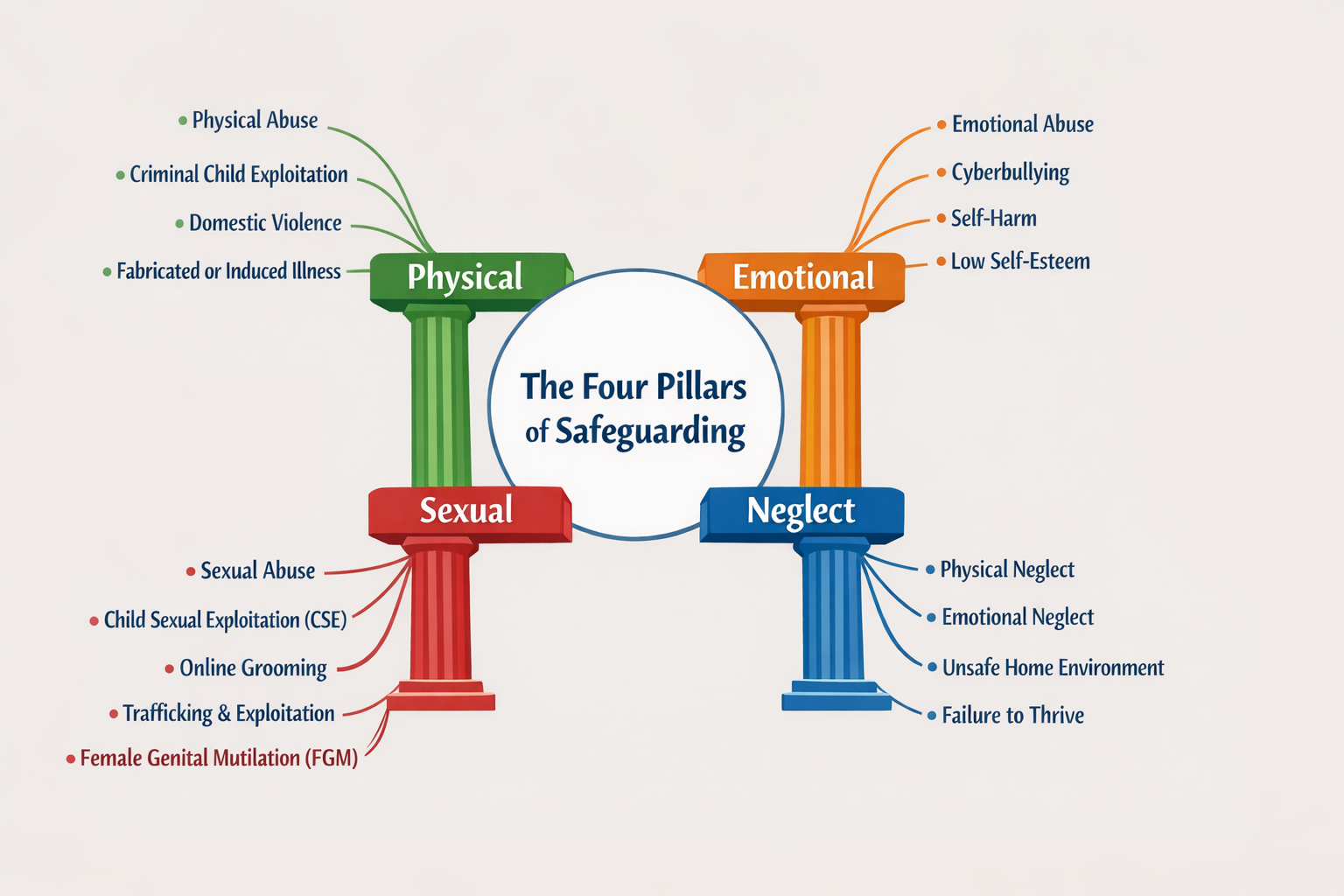
Categories Infographic © Lane Anthony

Case Study:   Sara Sharif (Physical Abuse)

Sara Sharif

Professional Analysis:   Sara suffered extensive physical abuse masked by a narrative of “unruliness.”

In practice, be alert to multiple injuries at different stages. injuries in SEND learners are often dismissed as “meltdowns.” Apply professional curiosity.

Case Study:   Arthur Labinjo-Hughes (Emotional Abuse)

Arthur Labinjo-Hughes © Lane Anthony

Professional Analysis:   Arthur was subjected to psychological torture and isolation.

Look for signs of “fading away.” Emotional abuse leaves no scars but manifests as total loss of Joy. Arthur’s cries for help were ignored.

Case Study:   Vincent Chan (Sexual Abuse & Grooming)

Vincent Chan © Lane Anthony

Professional Analysis:   Exploitation by a trusted nursery practitioner.

Monitor adult-child boundaries with total consistency. Never assume a “friendly” adult is safe if they isolate a learner.

Case Study:   Baby Victoria (Chronic Neglect)

Baby Victoria © Lane Anthony

Professional Analysis:   Death from exposure following transience and omission of care.

Neglect is an omission of care. Report the very first omission of a basic survival need.

Neuro-Inclusive Lens:   Masking and   Fawning

Hidden Vulnerability:   Masking.
Neurodivergent children may “mask” their distress to fit in. A child appearing “fine” or “compliant” may be exerting energy to hide abuse.
Fawning:   Trauma Response.
Fawning is a trauma response to appease adults to stay safe. Investigate “over-compliance.”

Module 3

Professional Conduct and Contextual Safeguarding

Introduction:   County Lines

County Lines © Lane Anthony

Criminal Exploitation:   Urban gangs using children to transport drugs.

Coercion through debt-bondage. Neurodivergent learners are targeted for their loyalty. Choice is irrelevant.

Statutory Framework:   The 4Cs of Online Risk

Categorising Digital Harm:  
  • Content:   Exposure to inappropriate material.
  • Contact:   Subject to grooming or exploitation.
  • Conduct:   Personal behaviour causing harm.
  • Commerce:   Gambling, phishing, scams.
© Lane Anthony

Digital Case Study:   Molly Russell

Molly Russell © Lane Anthony

Professional Analysis:   Danger of algorithm content (Content Risk).

Monitor if online feeds reinforce harmful thoughts. Molly died after algorithmic exposure to self-harm.

Neuro-Inclusion:   Communication Risks

Literal Interpretation:  
SEND learners are highly vulnerable to trickery. Model “Safe Professional Boundaries” explicitly. Literal thinkers can be misled.
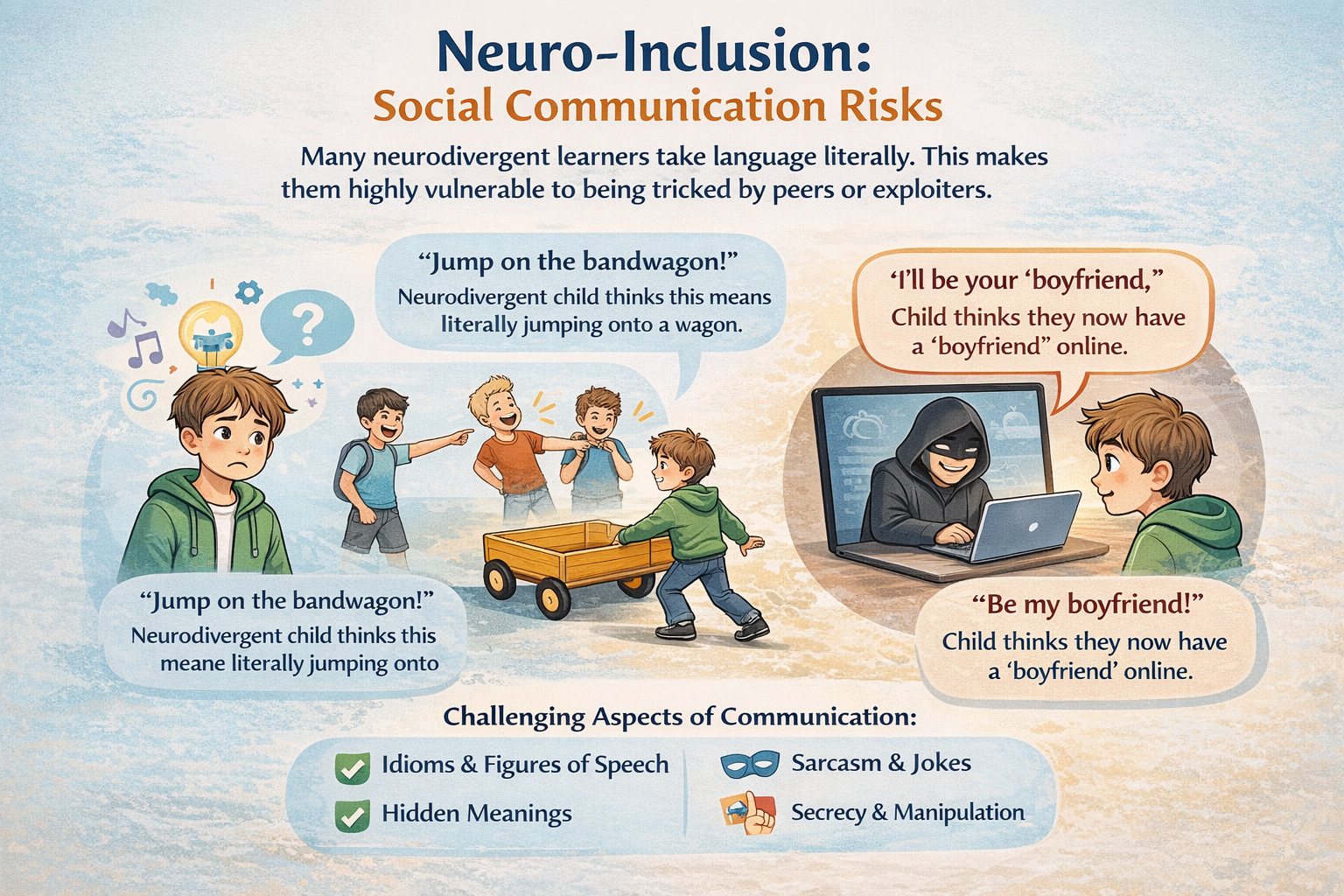
Communication Risk © Lane Anthony

Your Practice:   Precise Recording of Context

Environment Details:  
Include “where” and “with whom”. Instead of “friends,” write exact location and description of individuals.
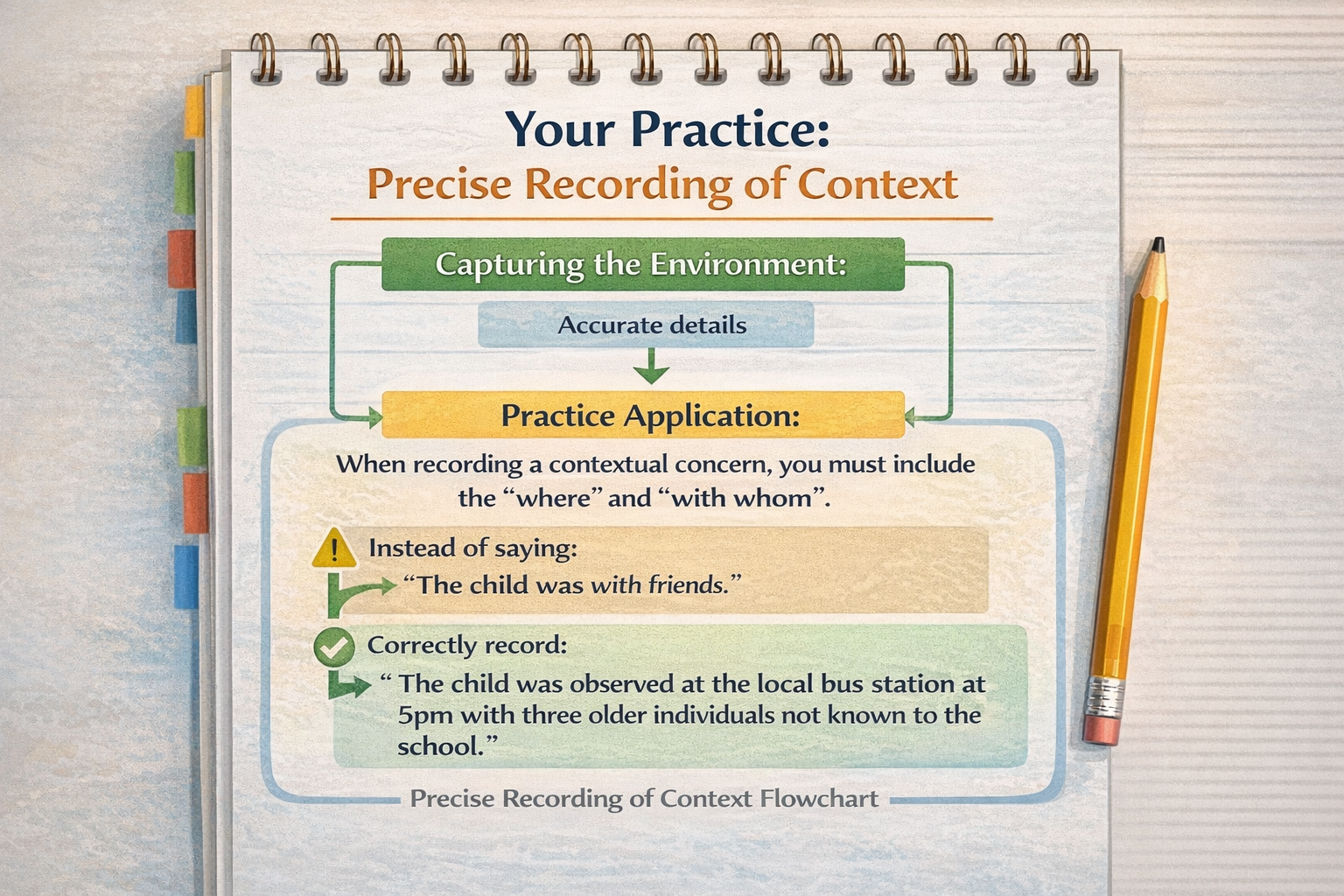
Recording Context © Lane Anthony

End of Part 1

Please load the Part 2 file to continue with Module 4, 5, 6, and the Course Closing.

Slide 1 of 122